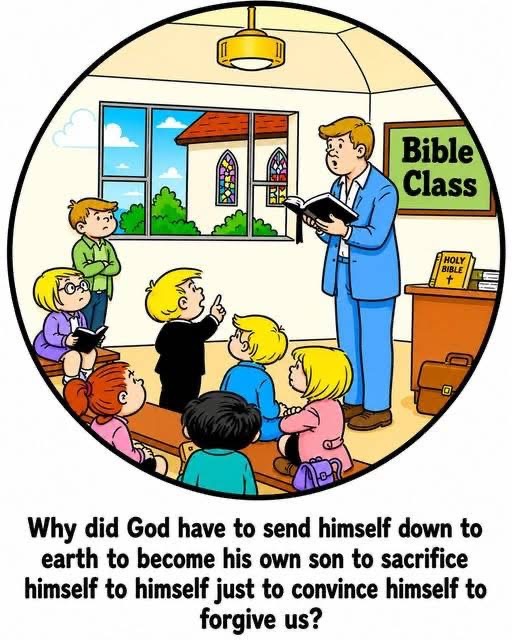
This image highlights a common, satirical summary of Christian theology, but from a mainstream Christian perspective (Trinitarianism), it oversimplifies and misrepresents the doctrine of the Incarnation and Atonement.
Here is how mainstream Christian theology breaks down the concepts involved in that question:
1. “God sent himself down… to become his own son”
- The Oversimplification: This phrasing assumes Modalism (or Sabellianism)—an ancient view rejected by mainstream Christianity which holds that God is a single person who simply shifts roles or “wears different masks” (Father, Son, Spirit).
- The Christian View: The doctrine of the Trinity states that God is one God in three distinct Persons: God the Father, God the Son (Jesus Christ), and God the Holy Spirit. They share the exact same divine essence, but the Father is not the Son, and the Son is not the Father. So, the Father sent the Son; God did not literally “become His own Son.”
2. “To sacrifice himself to himself”
- The Oversimplification: It frames the sacrifice as a strange internal transaction where God appeases a arbitrary urge of His own.
- The Christian View: In Christian theology (particularly views like Substitutionary Atonement), God’s character involves both perfect justice and perfect love:
- Justice: Sin carries a real moral weight and consequence (separation from God/death). God cannot simply ignore or sweep evil under the rug without compromising perfect justice.
- Love: Rather than requiring humanity to pay the penalty it could never satisfy, God takes the burden upon Himself. The Son willingly absorbs the consequence of human sin on the cross to satisfy the demands of divine justice while offering mercy.
3. “Just to convince himself to forgive us?”
- The Oversimplification: It presents God as reluctant or needing to “trick” or “persuade” Himself into being forgiving.
- The Christian View: In Christian teaching, God didn’t need to be convinced to love humanity—love was the motivation from the very start. As John 3:16 states, “For God so loved the world that he gave his only begotten Son…” The sacrifice wasn’t to change God’s heart toward humans, but to provide a righteous, legal, and moral framework for reconciling humanity to God without ignoring moral wrongdoing.
In short: As a meme critique of Modalism, it makes a logical point. But as a characterization of traditional Christian doctrine, it collapses distinct personal relationships within the Trinity and misinterprets the relationship between God’s justice and love.
Leave a Reply