Category: Science

  • Biological evolution is dead in the water of Darwin’s warm little pond

    Biological evolution is dead in the water of Darwin’s warm little pond


    The Core Premise: The Challenge of Co-Origination


    The Concept of Co-Origination: The authors introduce the novel argument that the transition from non-life to life requires multiple specific events to happen simultaneously in both time and space.
    The Enzyme-Vitamin Dilemma: Specifically, many essential biological enzymes cannot function without a corresponding coenzyme derived from a vitamin. For life to originate, both the complex enzyme and its required vitamin/coenzyme companion must emerge together.
    The Failure of Natural Selection: Because an enzyme without its cofactor (or vice versa) provides no survival advantage and represents a futile expenditure of energy, Darwinian survival of the fittest cannot select or preserve them individually. Natural selection is impotent during abiogenesis because it cannot recognize or save changes that only have future value.


    Defining the Minimal Living Cell


    To evaluate the likelihood of abiogenesis, the authors focus on the threshold of a modern minimal cell model, referencing Mycoplasma genitalium and the synthetic JCVI-syn3.0.
    For their calculations, they isolate a highly streamlined system consisting of 8 core biochemical processes (such as protein, DNA, RNA, and lipid synthesis), which require a total of 70 unique enzymes and 10 unique coenzymes.


    Probability and Statistical Impossibility


    Generous Assumptions: To test mainstream evolutionary doctrine, the authors choose highly generous, unrealistically favorable parameters—assuming a warm little pond already abiotically stocked with all required amino acids, nucleotides, lipids, and an energy source (ATP).


    The Mathematical Verdict: Using mathematical models for an uninterrupted sequence of events required to build this minimal metabolic ensemble, the authors compute total probabilities based on varying ratios of generating an enzyme versus a coenzyme.
    Even under the most absurdly optimistic assumptions, the probability ranges from 1 in 10^227 down to 1 in 10^1137. The authors note that an exponent of 80 is sufficient to account for all particles in the known universe, rendering the naturalistic assembly of first life statistically impossible and absurdly improbable.


    Conclusion


    The authors conclude that mainstream biology must reboot its approach to evolutionary theory. They assert that time alone cannot serve as the hero of abiogenesis, and that the necessity for the co-origination of essential components deals a fatal blow to the concept of survival of the fittest as a mechanism for explaining the origin of life.

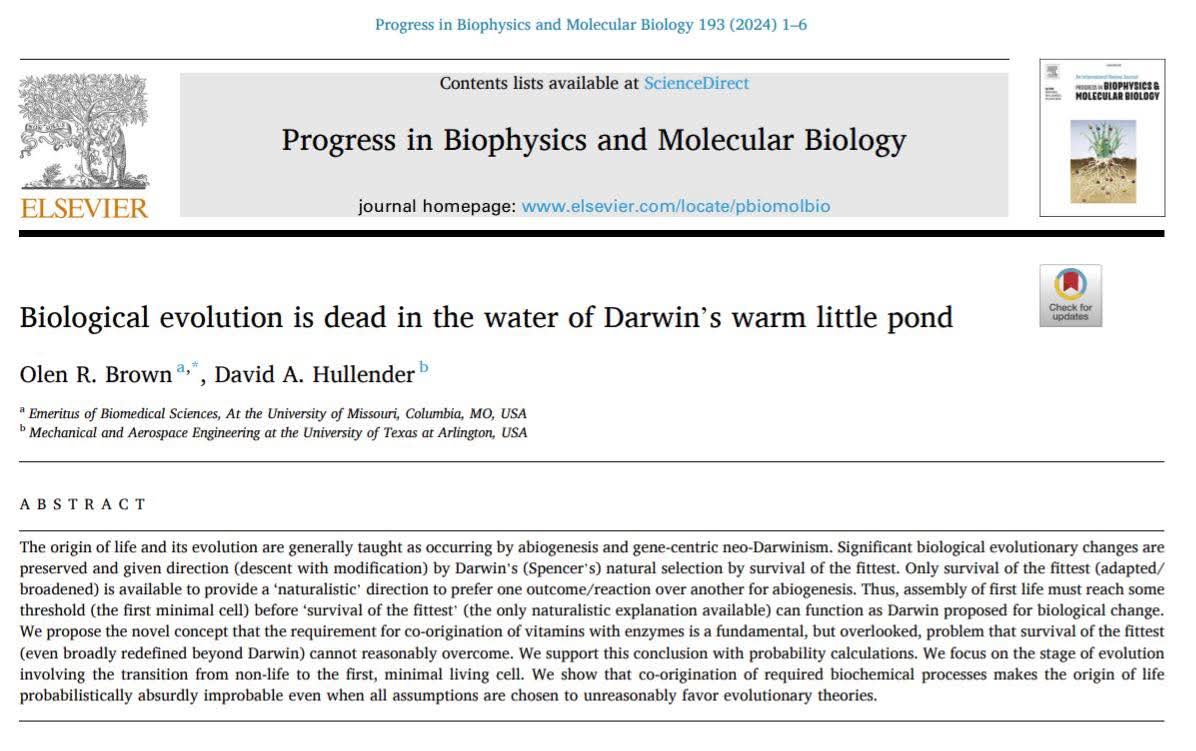
    “Published Journal Article from Progress in Biophysics and Molecular Biology

    1. Conclusions
      Calculated probabilities for the origin of life are absurdly improbable even when highly favorable assumptions are made. This agrees with the use of ‘absurd’ for probability statements by Eigen and that Wald (1954) found it necessary to use ‘miracles’ to justify his use of ‘impossible becomes possible’. The origin of life and its evolution cannot be ‘explained’ by a near-infinite sequence of minute changes given direction via selection by survival of the fittest. The death knell is the necessity for co-origination in space and in time, in one genome or perhaps two contiguous genomes (or whatever assumed the function before there was a genome) of all the structures and functions that are essential for life.
      The calculated probabilities reach absurd values as low as 1 chance in 10^1137 trials and rise to only one chance in 10^227 trials when one allows a coenzyme and an enzyme to be repeatedly created with an average absurdly high probability, respectively, of 1 in 10 to 1 in 1000 random trials. The exponents 1137 and 227 can be compared with exponents required for other large numbers: an exponent of 11 suffices for the number of stars in our galaxy and it is estimated that the exponent 80 is sufficient for all the particles in the universe. ‘Science’ has spent more than a century and a half worshiping at the altar of an idea that has few scientific clothes (surely no ensemble); we are on a yellow brick road leading only to a wonderful wizard. Like Alice we are not in Kansas anymore; natural selection is not natural but is given powers that are magical and miraculous. Natural selection, survival of the fittest and time are the great pretenders—they pretend we are doing well, but they pretend too much. We must reboot the computer called biological evolution. Time (even billions of years) is not the hero of the plot; however, for scientific understanding of biological evolution, time is of the essence.”

    Citation:
    Contents lists available at ScienceDirect
    Progress in Biophysics and Molecular Biology
    journal homepage: www.elsevier.com/locate/pbiomolbio

    Biological evolution is dead in the water of Darwin’s warm little pond
    Olen R. Brown a,*
    , David A. Hullender b
    a Emeritus of Biomedical Sciences, At the University of Missouri, Columbia, MO, USA b Mechanical and Aerospace Engineering at the University of Texas at Arlington, USA

  • Is abiogenesis and macroevolution true

    When scientists or the public talk about “macroevolution” (large-scale evolutionary changes that occur over geological time, resulting in the formation of new species, genera, or families), they are often looking at two different things:

    1. The overall fact of common descent, which is overwhelmingly proven by multiple independent lines of evidence.
    2. The specific, step-by-step mechanical pathways of how every single complex trait or lineage split occurred, which is where the active, unproven frontiers of science lie.
      There is nothing in macroevolution that has been shown to be mathematically, physically, or biologically impossible. However, there are massive gaps in our knowledge, highly debated mechanisms, and complex biological transitions that we haven’t fully “proven” or mapped out yet.
      Here are the major areas where macroevolutionary science faces its biggest questions, missing pieces, and current limitations.

    1. The Ultimate Frontier: The Origin of Life (Abiogenesis)

    While technically a distinct field from evolution—evolution explains how life changes once it exists, while abiogenesis explains how life started—they are deeply intertwined in the public mind.
    We currently do not know how the very first self-replicating, living cellular structures arose from non-living chemicals.

    • What is missing: While we have proven that the building blocks of life (amino acids, RNA bases) can form spontaneously in primordial conditions, we have not yet proven the exact chemical pathway that links these loose molecules into a functioning, metabolizing protocell.
    • Does it look impossible? No. Fields like RNA-world research and hydrothermal vent chemistry show plausible pathways, but we currently lack a definitive, proven “recipe.”

    2. “The Missing Steps” in the Fossil Record (Punctuated Equilibrium)

    One of the oldest criticisms of macroevolution is the apparent lack of transitional fossils for certain species. If evolution is a slow, gradual accumulation of tiny changes, the fossil record should look like a perfectly smooth, continuous gradient. Instead, it often looks like a species appears suddenly, stays the same for millions of years, and then disappears.

    • The Scientific Explanation: Evolutionary biologists Stephen Jay Gould and Niles Eldredge proposed Punctuated Equilibrium. They argued that evolution happens rapidly in small, isolated populations (where transitions are rarely preserved as fossils) followed by long periods of stability.
    • The Unproven Element: Because fossilization is incredibly rare, we are missing the exact, generation-by-generation physical transitions for many lineages. We have spectacular transitional sequences for whales, horses, and birds, but for many other groups, we only have the “before” and “after” snapshots.

    3. Explaining Sudden Bursts of Diversity (The Cambrian Explosion)

    Roughly 540 million years ago, a massive variety of complex, multicellular animal phyla appeared in the fossil record in a relatively short geological window (around 20 million years). This is known as the Cambrian Explosion.

    • The Challenge: To some, the sudden appearance of radically different body plans (arthropods, mollusks, chordates) looked “impossible” under standard, slow Darwinian evolution.
    • What we are still proving: Scientists are still trying to prove which trigger was the primary driver. Was it an environmental trigger (a sudden rise in atmospheric oxygen), a genetic trigger (the evolution of Hox genes that dictate body layouts), or an ecological trigger (the invention of eyes and active predation)? It remains one of macroevolution’s most intensely studied puzzles.

    4. Gaps in Mapping the “Genotype-to-Phenotype” Map

    Thanks to modern genetics, we can compare the DNA of a chimpanzee and a human, or a land mammal and a whale, and pinpoint the genetic differences. However, knowing which genes are different is not the same as proving how those genetic changes physically altered the animal during its embryonic development.

    • The Frontier: The field of Evolutionary Developmental Biology (Evo-Devo) is currently trying to map out exactly how small mutations in “switch” genes (regulatory DNA) translate into massive physical changes in a growing embryo.
    • The Current State: We understand the broad strokes (like how the electric eel repurposed its muscle genes), but for the vast majority of complex evolutionary traits, we cannot yet write out the exact, definitive step-by-step genetic script that caused the structural transformation.

    Why “Unproven” Does Not Mean “Impossible”

    In science, there is a strict difference between an unsolved puzzle and an impossibility.
    Whenever a trait looks “irreducibly complex” (meaning it seems impossible for it to have evolved because removing any one part makes the whole system fail), closer inspection usually reveals a natural path. Just like the electric eel’s weapon started as a weak navigation tool, complex structures like the human eye or the blood-clotting cascade have been proven to develop through co-option (taking an old tool and using it for a new job) and gradual refinement.
    Macroevolutionary scientists do not claim to have a complete, step-by-step blueprint of every biological event over the last 3.8 billion years. What they do have is a robust framework where every new fossil, genetic sequence, and geographical discovery continues to validate the core mechanism of natural selection.