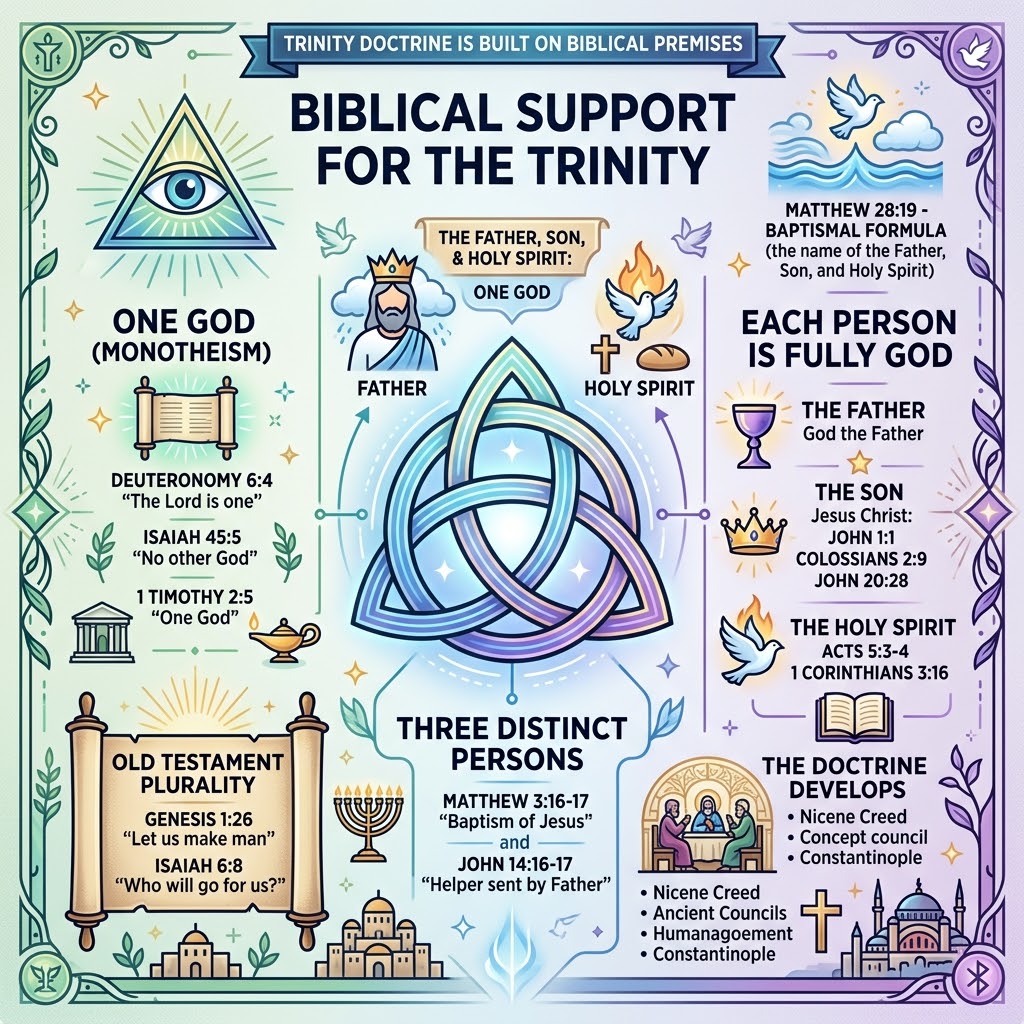
While the word “Trinity” never appears explicitly in the text, the doctrine is built systematically on three Biblical premises: there is only one God, the Father, Son, and Holy Spirit are distinct persons, and each person is fully God.
Below are the key scriptures categorized by how they support the triune nature of God.
Passages Mentioning All Three Persons Together
Matthew 28:19 “Go therefore and make disciples of all nations, baptizing them in the name of the Father and of the Son and of the Holy Spirit…” (Notice “name” is singular, reflecting one God in three persons).
Matthew 3:16 17 “And when Jesus was baptized… he saw the Spirit of God descending like a dove and coming to rest on him; and behold, a voice from heaven said, ‘This is my beloved Son, with whom I am well pleased.’”
2 Corinthians 13:14 “The grace of the Lord Jesus Christ and the love of God and the fellowship of the Holy Spirit be with you all.”
Ephesians 4:4 6 “There is one body and one Spirit… one Lord, one faith, one baptism, one God and Father of all…”
1 Peter 1:2 “…according to the foreknowledge of God the Father, in the sanctification of the Spirit, for obedience to Jesus Christ…”
1 John 5:7 (KJV/NKJV) “For there are three that bear record in heaven: the Father, the Word, and the Holy Ghost: and these three are one.” (Note: Textual scholarship notes this verse, known as the Johannine Comma, is absent from the earliest Greek manuscripts).
The Deity of Jesus Christ (The Son)
John 1:1, 14 “In the beginning was the Word, and the Word was with God, and the Word was God… And the Word became flesh and dwelt among us…”
John 10:30 “I and the Father are one.”
John 20:28 “Thomas answered him, ‘My Lord and my God!’”
Colossians 2:9 “For in him the whole fullness of deity dwells bodily…”
Hebrews 1:8 “But of the Son he says, ‘Your throne, O God, is forever and ever…’”
Titus 2:13 “…waiting for our blessed hope, the appearing of the glory of our great God and Savior Jesus Christ.”
Isaiah 9:6 “For to us a child is born… and his name shall be called Wonderful Counselor, Mighty God, Everlasting Father, Prince of Peace.”
The Deity and Personhood of the Holy Spirit
Acts 5:3 4 “Peter said, ‘Ananias, why has Satan filled your heart to lie to the Holy Spirit?… You have not lied to man but to God.’”
1 Corinthians 3:16 “Do you not know that you are God’s temple and that God’s Spirit dwells in you?”
1 Corinthians 2:10 11 “…For the Spirit searches everything, even the depths of God… So also no one comprehends the thoughts of God except the Spirit of God.”
John 14:16 17, 26 “And I will ask the Father, and he will give you another Helper… the Holy Spirit, whom the Father will send in my name, he will teach you all things…”
The Plurality of God in the Old Testament
Genesis 1:26 “Then God said, ‘Let us make man in our image, after our likeness…’”
Genesis 3:22 “Then the Lord God said, ‘Behold, the man has become like one of us…’”
Isaiah 6:8 “And I heard the voice of the Lord saying, ‘Whom shall I send, and who will go for us?’”
Isaiah 48:16 “And now the Lord God has sent me, and his Spirit.”
The Monotheistic Foundation (God is One)
Deuteronomy 6:4 “Hear, O Israel: The Lord our God, the Lord is one.”
Isaiah 45:5 “I am the Lord, and there is no other, besides me there is no God…”
1 Timothy 2:5 “For there is one God, and there is one mediator between God and men, the man Christ Jesus…”
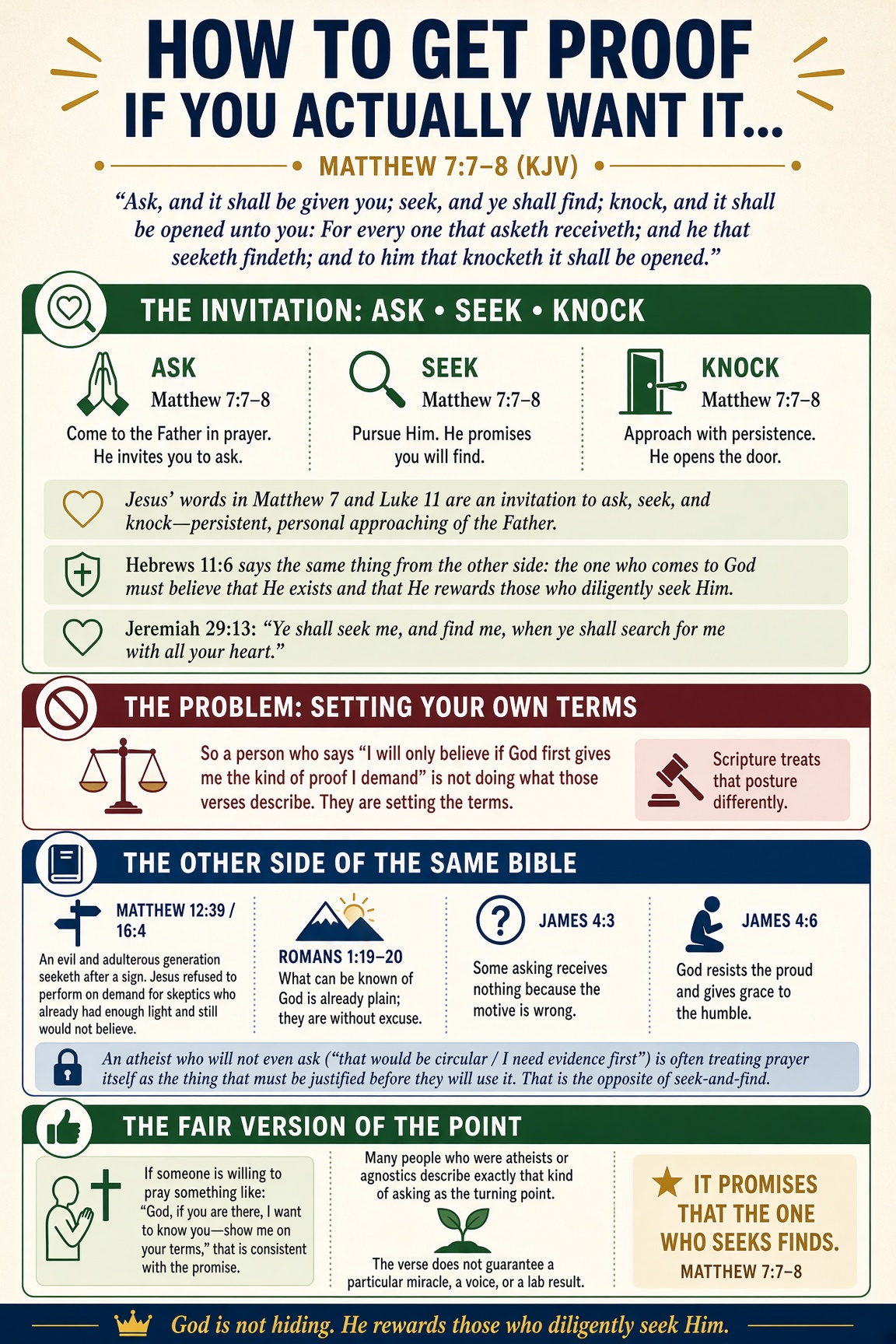
How to get proof: Matthew 7:7–8 (KJV) “Ask, and it shall be given you; seek, and ye shall find; knock, and it shall be opened unto you: For every one that asketh receiveth; and he that seeketh findeth; and to him that knocketh it shall be opened.” Jesus’ words in Matthew 7 and Luke 11 are an invitation to ask, seek, and knock—persistent, personal approaching of the Father. Hebrews 11:6 says the same thing from the other side: the one who comes to God must believe that He exists and that He rewards those who diligently seek Him. Jeremiah 29:13: “Ye shall seek me, and find me, when ye shall search for me with all your heart.” So a person who says “I will only believe if God first gives me the kind of proof I demand” is not doing what those verses describe. They are setting the terms. Scripture treats that posture differently. The other side of the same Bible Matthew 12:39 / 16:4 — “An evil and adulterous generation seeketh after a sign.” Jesus refused to perform on demand for skeptics who already had enough light and still would not believe. Romans 1:19–20 — what can be known of God is already plain; they are without excuse. James 4:3 — some asking receives nothing because the motive is wrong. James 4:6 — God resists the proud and gives grace to the humble. An atheist who will not even ask (“that would be circular / I need evidence first”) is often treating prayer itself as the thing that must be justified before they will use it. That is the opposite of seek-and-find. The fair version of the point If someone is willing to pray something like: “God, if you are there, I want to know you—show me on your terms,” that is consistent with the promise. Many people who were atheists or agnostics describe exactly that kind of asking as the turning point. The verse does not guarantee a particular miracle, a voice, or a lab result. It promises that the one who seeks finds.
This passage from the Gospel of Mark (Mark 11:12-14) is frequently cited by critics as an example of Jesus acting out of character or frustration. To understand how Christian theologians and biblical scholars interpret this specific event—often called The Cursing of the Fig Tree—it helps to look beyond the literal narrative into the rich layers of Jewish symbolism and prophetic action.
Here is how mainstream Christian interpretation unpacks this passage:
The Fig Tree as a Symbol of Israel In the Hebrew Bible, the fig tree is a common metaphor for the nation of Israel, its religious leaders, or the Temple in Jerusalem (as seen in prophets like Hosea, Jeremiah, and Micah).
The Illusion of Fruitfulness: By having leaves out of season, the tree advertised that it had fruit. In biblical times, early edible buds often appeared before the actual fruit, signaling a promising harvest.
The Hypocrisy Parallel: When Jesus approached the tree and found only leaves, it served as a living parable for the spiritual state of the Jerusalem Temple. The Temple looked grand, busy, and alive with religious activity (the leaves), but it lacked spiritual substance, justice, and genuine fruitfulness for God.
A Prophetic Action (Enacted Parable) In the Old Testament, prophets frequently performed dramatic, symbolic acts to deliver a message from God (such as Jeremiah smashing a clay jar or Ezekiel lying on his side for months).
Jesus was not throwing a petty, uncontrolled tantrum out of hunger; rather, He was performing an enacted parable.
Immediately following this event, Jesus enters the Temple and overturns the tables of the money changers (Mark 11:15-19). The cursing of the fig tree acts as a bookend or a visual preview of the judgment coming upon the hypocritical religious system in Jerusalem, which would culminate in the destruction of the Temple decades later in 70 AD.
Addressing the “Out of Season” Dilemma Critics often ask: Why punish a tree for not having fruit if it wasn’t the season?
Scholars note that if a tree had fully developed leaves in the spring, it should have had edible early buds, even if the main harvest wasn’t fully ripe. The leaves promised something the tree failed to deliver.
More importantly, because this is a symbolic parable rather than a gardening lesson, the temporal anomaly of the season highlights the spiritual point: professing righteousness without actual spiritual fruit is empty and ultimately subject to judgment.
Note: Christian theology views the cross and resurrection as the ultimate displays of God’s patience and self-sacrifice, rather than uncontrolled anger. In this interpretive framework, the withered fig tree is a stern prophetic warning about spiritual barrenness, rather than a literal punishment of an innocent plant.
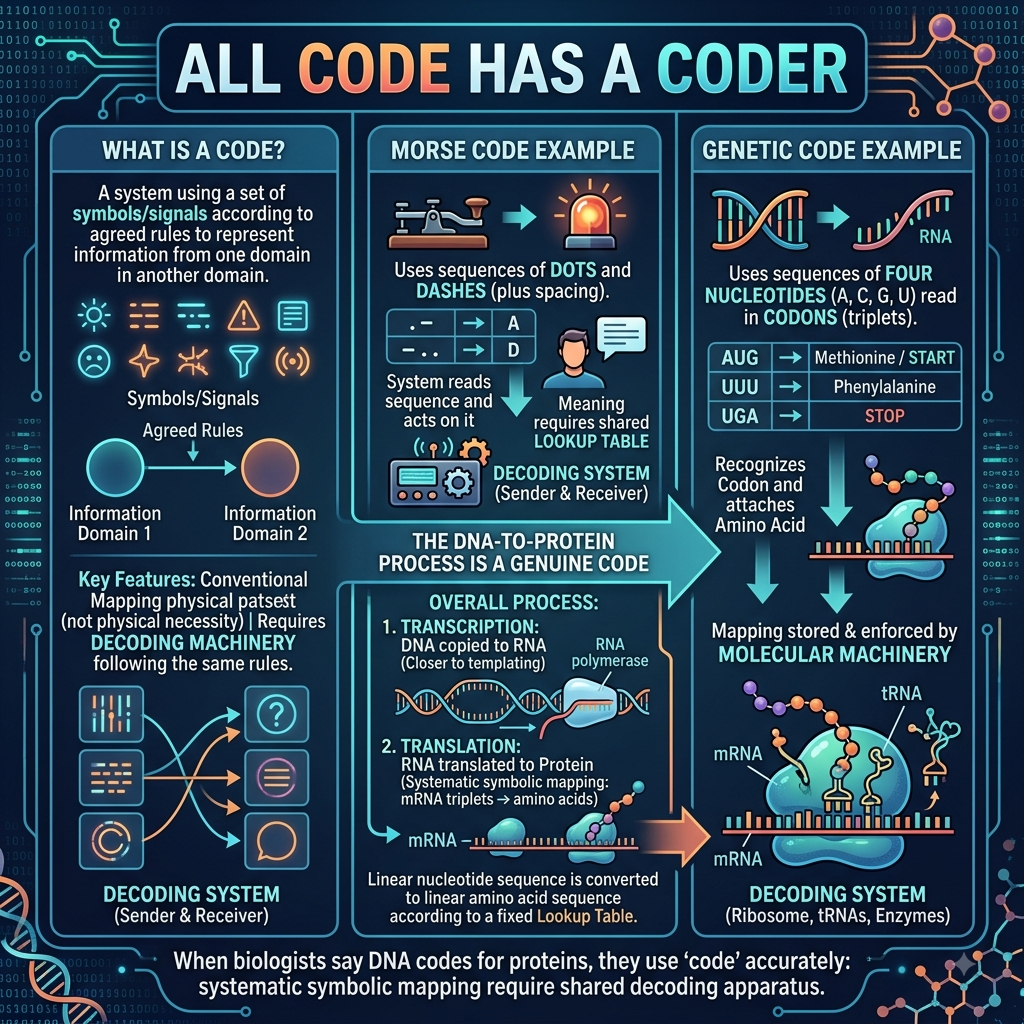
DNA codes for RNA and RNA codes proteins. The DNA-to-RNA-to-protein process is a genuine code in the same fundamental sense that Morse code is a code.
A code is a system that uses a set of symbols or signals according to agreed rules to represent information from one domain in another domain. The mapping is conventional rather than forced by simple physical necessity, and it requires a decoding machinery that follows the same rules.
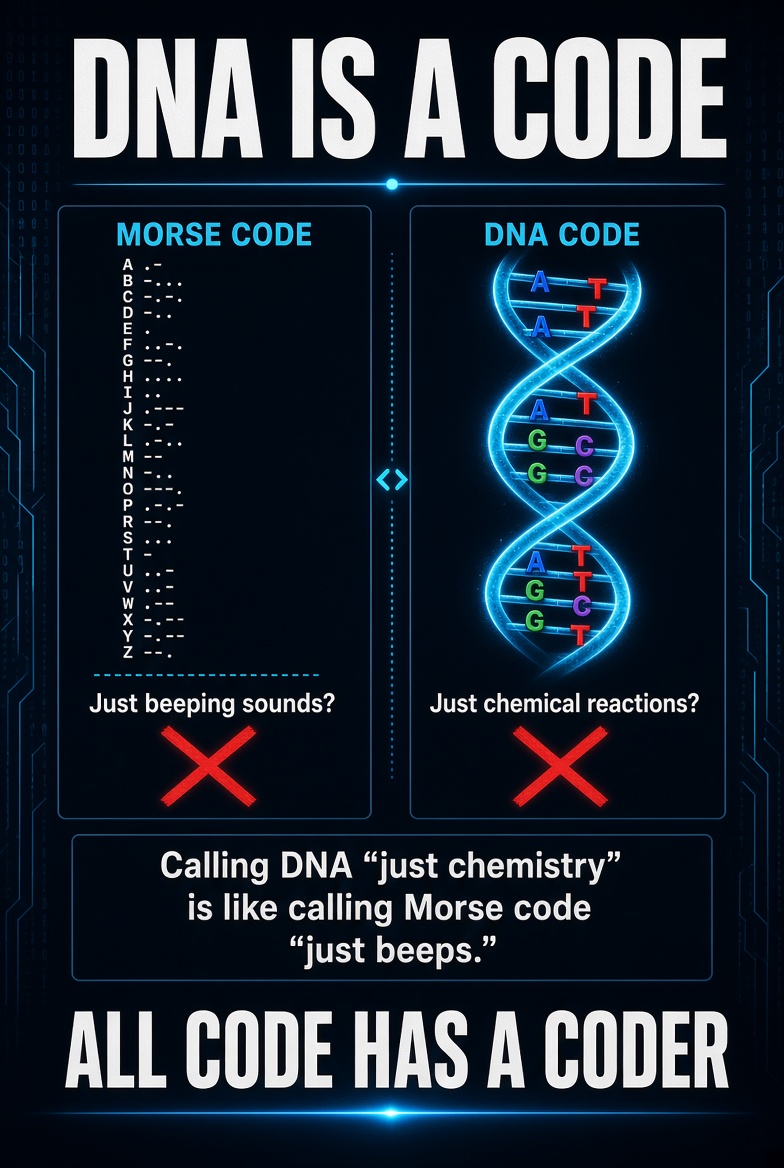
Morse code takes sequences of two symbols—dot and dash, plus spacing—and maps specific combinations to letters, numbers, and punctuation. The pattern itself does not chemically or physically force a particular letter to appear. The meaning exists only because sender and receiver share the same lookup table. Without the agreed mapping and a system that can read the sequence and act on it, the dots and dashes are just pulses.
The genetic code works the same way. DNA and RNA use sequences of four nucleotide symbols (A, C, G, T/U). These are read in groups of three, called codons. Each codon is mapped to a specific amino acid or to a start or stop signal according to the genetic code. For example, AUG corresponds to methionine and also serves as the start signal, UUU corresponds to phenylalanine, and UGA is a stop signal.
This mapping is parallel to Morse code. A specific sequence of symbols stands for a specific item in another alphabet. The sequence itself does not magically become the amino acid. The cell possesses a decoding system—the ribosome, transfer RNAs, and related enzymes—that recognizes the codon and attaches the corresponding amino acid. The mapping is conventional in the same sense that Morse is conventional: there is no simple chemical reason why one particular codon must mean one particular amino acid. The mapping is stored and enforced by the molecular machinery that reads it.
The overall process has two main steps. DNA is transcribed into RNA by copying the sequence according to base-pairing rules. This step is closer to direct templating than full translation. RNA is then translated into protein. The linear sequence of nucleotides in messenger RNA is read in triplets and converted into a linear sequence of amino acids. This is the Morse-code-like step: a systematic symbolic mapping from one alphabet to a completely different alphabet.
When biologists say that DNA codes for proteins, they are using the word “code” accurately. An information-bearing sequence written in one symbolic system is converted, according to a fixed lookup table, into a sequence written in another symbolic system. Both the genetic code and Morse code are rule-based, conventional mappings from sequences of symbols in one domain to meaningful units in another domain, and both require a shared decoding apparatus to function.
DNA is a code. The four bases (A, T, C, G) function as discrete symbols arranged in specific sequences that carry instructions. Those sequences are read, transcribed, and translated according to a mapping ruleset (the genetic code) that is itself arbitrary with respect to the chemistry. The chemistry makes the system possible; it does not dictate what the sequences mean. Morse code works the same way. Dots and dashes are just timed electrical pulses or audio tones. The physical events are “just beeping.” The meaning exists only because an agreed-upon coding system maps those patterns onto letters and words. Remove the coding convention and you’re left with noise. Calling DNA “just chemistry” or “just chemical reactions” is therefore equivalent to calling Morse code “just beeping.” It describes the substrate while ignoring the informational layer that makes the system functional. The chemistry is necessary but not sufficient to explain the presence of functional, sequence-specific information. This is why the distinction between chemistry and information is central in origin-of-life discussions. Random chemical processes readily produce molecules. They do not readily produce large amounts of specified information that maps onto functional outcomes according to an independent coding system.
This image points out a central issue in philosophical theology—often called the Problem of Heavenly Freedom—and its first premise about traditional Christian theology is correct, even if theologian-approved answers exist for the question it raises. Here is a breakdown of how the theology works and how Christian thinkers respond to this exact question:
1. Is the premise about Heaven true?
Yes. Major historical theologians—such as St. Augustine and Thomas Aquinas—distinguished between different stages of human freedom:
In Eden / On Earth (Posse non peccare): Humans have the ability to choose good or evil (libertarian free will / decision-making prone to temptation).
In Heaven (Non posse peccare): Redeemed humans retain free will, but they are “glorified.” Having seen God face-to-face (the Beatific Vision) and experienced complete transformation, their desires are fully aligned with God’s goodness. They can choose whatever they want, but they will never want to choose evil. Because God Himself possesses free will yet cannot sin, traditional theology holds that absolute freedom doesn’t require the ability to do wrong.
2. Why didn’t God just start Adam and Eve like that?
Theologians offer a few key reasons for why Eden was created as a testing ground rather than starting straight at “Heaven mode”:
Soul-Making & Freely Chosen Love: Many Christian philosophers (like C.S. Lewis or Alvin Plantinga) argue that genuine love and moral virtue must be freely chosen through trial and character growth. If humans were created incapable of desiring wrong from day one, their choice to love God would lack moral development.
Heaven as a Process of Redemption: In classic Christian doctrine, heavenly perfection isn’t just an “out-of-the-box” state; it is the result of overcoming, repenting, and being transformed. Heaven is for those who choose God over self-centeredness after experiencing a world where turning away was an option.
Knowledge vs. Ignorance: In Heaven, souls have full experiential knowledge of what sin leads to (pain, separation, evil). That knowledge permanently reshapes their perspective, whereas Adam and Eve began in innocence without that deep, tested understanding.
The Philosophical Debate
From a secular or critical standpoint, the image highlights a fair logical tension: If a state exists where free beings freely choose good 100% of the time, God could theoretically have created a world where everyone always chooses good without violating their freedom. Whether you find the Christian counter-arguments convincing depends heavily on whether you view moral development and trial as a necessary precursor to eternal perfection.
This image highlights a common, satirical summary of Christian theology, but from a mainstream Christian perspective (Trinitarianism), it oversimplifies and misrepresents the doctrine of the Incarnation and Atonement.
Here is how mainstream Christian theology breaks down the concepts involved in that question:
1. “God sent himself down… to become his own son”
The Oversimplification: This phrasing assumes Modalism (or Sabellianism)—an ancient view rejected by mainstream Christianity which holds that God is a single person who simply shifts roles or “wears different masks” (Father, Son, Spirit).
The Christian View: The doctrine of the Trinity states that God is one God in three distinct Persons: God the Father, God the Son (Jesus Christ), and God the Holy Spirit. They share the exact same divine essence, but the Father is not the Son, and the Son is not the Father. So, the Father sent the Son; God did not literally “become His own Son.”
2. “To sacrifice himself to himself”
The Oversimplification: It frames the sacrifice as a strange internal transaction where God appeases a arbitrary urge of His own.
The Christian View: In Christian theology (particularly views like Substitutionary Atonement), God’s character involves both perfect justice and perfect love:
Justice: Sin carries a real moral weight and consequence (separation from God/death). God cannot simply ignore or sweep evil under the rug without compromising perfect justice.
Love: Rather than requiring humanity to pay the penalty it could never satisfy, God takes the burden upon Himself. The Son willingly absorbs the consequence of human sin on the cross to satisfy the demands of divine justice while offering mercy.
3. “Just to convince himself to forgive us?”
The Oversimplification: It presents God as reluctant or needing to “trick” or “persuade” Himself into being forgiving.
The Christian View: In Christian teaching, God didn’t need to be convinced to love humanity—love was the motivation from the very start. As John 3:16 states, “For God so loved the world that he gave his only begotten Son…” The sacrifice wasn’t to change God’s heart toward humans, but to provide a righteous, legal, and moral framework for reconciling humanity to God without ignoring moral wrongdoing.
In short: As a meme critique of Modalism, it makes a logical point. But as a characterization of traditional Christian doctrine, it collapses distinct personal relationships within the Trinity and misinterprets the relationship between God’s justice and love.
TINSA (Trauma-Induced Sexual Addiction), a neurobiological treatment model created by Dr. Michael Barta, treats compulsive sexual behaviors by targeting the underlying autonomic nervous system dysregulation caused by developmental trauma. Rather than focusing solely on symptom containment (abstinence), the TINSA framework utilizes a specialized collection of trauma-informed and neuro-experiential techniques across its three distinct stages of recovery:
These core techniques bypass the analytical “thinking brain” to access the “reactive brain” where traumatic memories and nervous system triggers are physically stored.
Brainspotting (BSP): The primary trauma protocol used in TINSA. Practitioners guide the client’s gaze using a pointer to locate specific eye positions (“brain spots”) that correspond to physical, somatic tension or distress. Holding this visual fixation allows the brain to process deep-seated, subconscious trauma without requiring detailed verbal recollection.
Somatic Experiencing & Tracking: Clients are trained to pinpoint and describe physical, bodily sensations (e.g., chest tightness, heart racing) to map out how their nervous system responds to trauma triggers and addictive urges.
Eye Movement Desensitization and Reprocessing (EMDR): Used to integrate bilateral stimulation (left-to-right brain activation) to help process severe childhood wounds, such as abandonment or abuse, reducing the emotional charge of those memories.
The initial phase focuses on shifting the client from self-blame to neurological understanding.
Nervous System Mapping (Psychoeducation): Teaching the client the mechanics of their autonomic nervous system (ANS) and how early trauma hijacked their dopamine-reward pathways.
Arousal Self-Regulation Tools: Concrete coping mechanisms drawn from Dialectical Behavior Therapy (DBT)—specifically mindfulness, distress tolerance, and emotional regulation techniques—to safely de-escalate “fight-or-flight” states without turning to compulsive behaviors.
This phase addresses internal psychology, behavioral containment, and generational patterns.
Internal Family Systems (IFS) / Parts Work: Identifying and dialoguing with different “parts” of the self (such as the addictive part acting as a protector, or the isolated “inner child”) to alleviate deep shame and self-imposed isolation.
Three-Tiered Boundary Mapping: Establishing a structured relapse-prevention framework:
Inner Boundaries: Definition of problematic acting-out behaviors to completely avoid.
Middle Boundaries: Tracking and managing near-miss triggers, situations, or behavioral warning signs.
Outer Boundaries: Healthy lifestyle habits, hobbies, and self-care that reinforce recovery.
Genograms (Intergenerational Trauma Analysis): Constructing detailed family trees to visually trace how core values, relationship dynamics, and unspoken behavioral expectations were passed down through generations.
The final stage shifts the client away from hyper-isolated self-reliance toward healthy, interpersonal bonding.
Grounded Group Therapy: Engaging with peers in recovery using strict rules of radical transparency and honesty to break down denial, dismantle shame, and practice interpersonal vulnerability.
Parallel Partner Support & Empathy Restoration: Integrating dedicated therapeutic support for the partner. This includes structured disclosure preparation and boundary work aimed at addressing betrayal trauma and safely rebuilding mutual relational safety.
SMART Recovery (Self-Management and Recovery Training) is a secular, science-backed program that is highly effective for both substance abuse and behavioral addictions, including compulsive sexual behavior and sex addiction.
Instead of the traditional 12 steps, the SMART Recovery Handbook is structured around a 4-Point Program. It is designed to help you understand what drives your behavior, gain control over your actions, and build a satisfying life outside of the addiction.
Here are the main steps and core tools from the SMART handbook, adapted to navigating recovery from sexual addiction:
Point 1: Building & Maintaining Motivation
Recovery begins with understanding why you want to change. Because compulsive sexual behavior often functions as an instant “mood changer” or escape from reality, finding lasting internal motivation is crucial to breaking the loop.
Cost-Benefit Analysis (CBA): You write down the short-term and long-term pros and cons of both continuing the sexual behavior and stopping it. This helps you clearly see how temporary physical relief (the “erotic haze”) is outweighed by long-term costs like broken trust, guilt, or loss of time.
Hierarchy of Values (HOV): You identify your top 5 most important life values (e.g., honesty, healthy relationships, career, self-respect). Comparing these values against your addictive behavior highlights how acting out directly betrays what you care about most.
Point 2: Coping with Urges
Urges and cravings are a normal, inevitable part of the rewiring process. Point 2 focuses on realizing that while an urge to act out can feel overwhelming, you do not have to act on it, and it will pass.
The DEADS Tool: A primary strategy used to handle intense urges in the moment:
Delay: Agree to wait 10 to 15 minutes before acting. Urges peak and then naturally subside if you don’t feed them.
Escape: Physically leave the triggering environment (e.g., close the laptop, step away from your phone, go to a different room).
Accept: Acknowledge the urge without judging yourself. It’s just a wave of dopamine-seeking behavior, not a command.
Distract: Engage your mind in a completely unrelated, absorbing activity.
Substitute: Replace the harmful behavior with a safe, healthy one.
Urge Log: Tracking your urges helps you identify your specific patterns, triggers (e.g., fatigue, loneliness, specific apps), and which tools worked best to defuse them.
Point 3: Managing Thoughts, Feelings, and Behaviors
Many people turn to compulsive sexual behavior to anesthetize painful emotions like anxiety, stress, or shame. SMART teaches you how to manage the uncomfortable feelings that trigger the desire to escape.
The ABC Tool (REBT/CBT-based): This helps you break down the cognitive chain reaction that leads to acting out:
A (Activating Event): The trigger (e.g., having a stressful day at work).
B (Beliefs): Your automatic thoughts about the event (e.g., “I can’t handle this stress, I need an escape right now”).
C (Consequences): The emotional and behavioral outcome (feeling anxious, leading to acting out).
D (Dispute): Challenging those automatic beliefs (e.g., “Is it true I can’t handle this? I’ve survived stressful days before without acting out”).
E (Effective New Belief): Creating a healthier approach (e.g., “This stress is uncomfortable, but temporary. I can manage it by taking a walk instead”).
Point 4: Living a Balanced Life
Active addiction consumes a massive amount of time, energy, and focus. When you step away from it, you are often left with a feeling of emptiness. Point 4 is about filling that space with meaningful, healthy pursuits.
VACI (Vital Absorbing Creative Interest): Finding positive hobbies, projects, or goals that fully capture your attention, bring you genuine joy, and help rebuild your dopamine system naturally.
Lifestyle Balance Pie: A visual assessment tool used to review different areas of your life (relationships, health, career, leisure) to see where you are out of balance and where you want to redirect your energy.
A Note on SMART Meetings: Unlike some groups, you are never required to share explicit or graphic details of your behaviors in a SMART meeting. You are always welcome to keep things general by referring to your challenges simply as “my behavior,” “acting out,” or “my primary challenge,” allowing you to focus entirely on the cognitive tools for healing.
Below are specific CBT techniques and statements that CSAT-certified clinicians commonly use for compulsive sexual behavior:
Thought Record Framework
CBT uses structured thought-record worksheets. You document:
The Cue (trigger)
Automatic Belief (thought that pops up)
Emotional Intensity (rate 1-10)
Resulting Behavior
Then you challenge and restructure the thought.
Common Automatic Thoughts & Restructured Statements
Automatic Thought
Restructured Alternative
“I have to watch porn/masturbate to feel good”
“I can experience relaxation and satisfaction by reading, exercising, or calling a supportive friend, which aligns with my values and long-term goals.”
“This urge is unbearable—I need to act on it”
“Urges are uncomfortable but temporary. I can let this feeling pass without acting on it.”
“One time won’t hurt—I’m already stressed”
“Each time I act reinforces the pattern. Staying consistent with my recovery goals serves me better than short-term relief.”
“I’m weak—I’ll never control this”
“Recovery is a skill that strengthens with practice. Each moment I choose differently builds resilience.”
“Everyone looks at attractive people—it’s normal”
“Noticing attraction is normal; acting compulsively on every urge isn’t serving my wellbeing.”
“I don’t deserve better”
“I deserve respect for myself and my long-term health, even when urges feel overwhelming.”
Specific CBT Challenging Questions
Therapists teach clients to ask themselves:
“What evidence shows that I can feel good without acting on this urge?”
“What evidence shows this will actually solve the problem I’m facing right now?”
“Is this thought based on fact or feeling?”
“Would I say this thought to a friend in my situation?”
“What would happen if I waited 10 minutes before deciding?”
Coping Plan Examples
After restructuring thoughts, you develop concrete action steps:
“Take a 10-minute mindfulness pause before making any decisions”
“Call a sponsor or supportive friend when urge intensity reaches 7/10”
“Engage in a hobby or physical activity for 15 minutes”
“Use a distraction technique (count backwards, name 5 things you see)”
Common Cognitive Distortions CSATs Watch For
According to addiction resources, these irrational thought patterns frequently appear:
“All-or-nothing” thinking (e.g., “I already slipped, so I might as well go all the way”)
Overgeneralization (e.g., “This always happens to me”)
“Should” statements (e.g., “I shouldn’t have this urge”)
Emotional reasoning (e.g., “I feel desperate, so I must be desperate”)
Important Note
These statements work best when practiced regularly—not just during crises. Many therapists recommend writing your own personalized versions of these statements and keeping them accessible (phone note, printed card) for when urges hit.
The key insight from CBT research: “People in CBT for addictions have half the number of relapses as those in traditional talk therapy.” The structured, skills-based approach matters.
The 12-step process for sex addiction is modeled closely after the original program created by Alcoholics Anonymous, adapted specifically to address compulsive sexual behavior. It provides a structured framework for individuals seeking recovery, emphasizing self-reflection, accountability, and community support.
Groups like Sex Addicts Anonymous (SAA) and Sexaholics Anonymous (SA) utilize these steps, though definitions of sobriety can vary depending on the specific fellowship.
The 12 Steps
Step 1: Admission Honesty We admitted we were powerless over our addictive sexual behavior—that our lives had become unmanageable.
Step 2: Hope Open-mindedness Came to believe that a Power greater than ourselves could restore us to sanity.
Step 3: Surrender Willingness Made a decision to turn our will and our lives over to the care of God as we understood God.
Step 4: Inventory Courage Made a searching and fearless moral inventory of ourselves.
Step 5: Confession Integrity Admitted to God, to ourselves, and to another human being the exact nature of our wrongs.
Step 6: Readiness Acceptance Were entirely ready to have God remove all these defects of character.
Step 7: Humility Humility Humbly asked God to remove our shortcomings.
Step 8: Amends List Compassion Made a list of all persons we had harmed, and became willing to make amends to them all.
Step 9: Restitution Justice Made direct amends to such people wherever possible, except when to do so would injure them or others.
Step 10: Maintenance Perseverance Continued to take personal inventory and when we were wrong promptly admitted it.
Step 11: Connection Spiritual Growth Sought through prayer and meditation to improve our conscious contact with God as we understood God, praying only for knowledge of God’s will for us and the power to carry that out.
Step 12: Service Charity Having had a spiritual awakening as the result of these steps, we tried to carry this message to other sex addicts and to practice these principles in all our affairs.
Key Differences in Sex Addiction Recovery
Unlike substance abuse programs where the goal is total abstinence from the substance, recovery from sex addiction looks a bit different:
Defining Sobriety: Because sex is a natural human behavior, total celibacy isn’t always the end goal. In fellowships like SAA, members define their own “inner circle” behaviors (the compulsive acts they want to stop, such as compulsive pornography use, anonymous encounters, or dangerous behaviors) in consultation with a sponsor.
The Spiritual Component: While the steps use the word “God,” 12-step programs stress that this can be any “Higher Power” of an individual’s choosing, including the support group itself or a secular concept of the universe.
A Tool, Not a Cure: The 12 steps are widely used as a peer-support tool, but medical professionals frequently recommend pairing them with specialized therapy, such as Cognitive Behavioral Therapy (CBT) or working with a Certified Sex Addiction Therapist (CSAT), to address underlying trauma or mental health factors.
there are several anonymous online options. Here’s what’s available:
12-Step Fellowships with Online/Phone Meetings (Free & Anonymous)
These all operate similarly to AA — you can attend using only a first name, no registration required, and they offer virtual meetings via phone, video, or chat:
Sex Addicts Anonymous (SAA) — saa-recovery.org
Offers web-based and phone meetings daily, worldwide
You can attend without sharing personal info
They’ll refer you to a meeting that fits your schedule
Sex and Love Addicts Anonymous (SLAA) — slaafws.org
Focuses on both sex and love/relationship addiction
Also hosts virtual meetings
Sexaholics Anonymous (SA) — sa.org
Maintains an international directory of online meetings
Same 12-step model
Sex and Porn Addicts Anonymous (SPAA) — spaa-recovery.org
Specifically addresses both sex and porn addiction together
Offers web-based meetings (e.g., their Chicago group)
Sexual Recovery Anonymous (SRA) — sexualrecoveryanonymous.org
Another fellowship option with virtual meetings
Other Useful Resources
Bill Herring’s compiled list (billherring.com/sex-addiction-support-forums) — a curated, no-cost directory of phone and online support forums for both addicts and partners. This is a great starting point if you’re not sure which group fits.
SMART Recovery (smartrecovery.org) — Not sex-specific, but offers online meetings based on cognitive-behavioral techniques rather than 12 steps. Some people prefer this approach. They also have online message boards.
A Few Practical Tips for Starting Out
You don’t have to speak at your first meeting. You can just listen. Most meetings welcome newcomers who stay silent.
Try a few different fellowships. Each has a slightly different focus and culture — what clicks for one person may not click for another.
Phone meetings are the most anonymous option — no camera, no username needed beyond a first name.
These are all free. No insurance, no payment, no paperwork.
The hardest part is usually logging into that first meeting. But everyone in that room was once sitting exactly where you are now — feeling the same hesitation. You don’t have to figure this out alone.
Breaking Mental Loops
What’s happening: Intrusive mental rehearsal occurs when your brain replays an image or experience repeatedly, trying to “finish” what it started. It’s part of the reinforcement cycle in compulsive behavior — the brain got a dopamine spike and keeps seeking more by holding onto the memory.
Immediate interruption techniques:
Label it — say aloud or internally, “this is an intrusive thought” or “my brain is looping.” Naming creates distance between you and the thought.
Grounding (5-4-3-2-1) — name 5 things you see, 4 things you feel physically, 3 things you hear, 2 things you smell, 1 thing you taste. This forces your nervous system back into the present moment.
Change your physical state — cold water on your face, stand up and walk, grip something textured. The brain struggles to hold the image when your body shifts engagement.
Scheduled worry time — tell yourself “I’ll think about this at a specific time for 10 minutes, not now.” Urgency often drops when you defer it.
Why shame makes it worse: Guilt releases stress hormones. The brain then seeks relief from that stress — often by returning to the original dopamine source. The shame fuels the loop rather than stopping it.
Urge Management
Urge Surfing
Urges behave like ocean waves — they build, peak, and then crash. Most urges last 15–30 minutes if you don’t feed them. The technique is to “surf” the wave rather than fight it:
Notice the urge without judging it: “I’m feeling an urge right now.”
Observe where you feel it in your body — tension, restlessness, heart rate.
Track whether it’s rising, peaking, or falling.
Remind yourself: this will pass on its own.
Don’t argue with it, don’t negotiate, don’t reason with it. Just watch it.
Fighting the urge directly often strengthens it. Observing it without acting weakens it.
Play the Tape Forward
When an urge hits, mentally fast-forward through what happens if you act on it — not just the moment of acting, but the aftermath. The guilt, the shame spiral, the damage to relationships, the setback in recovery. Then contrast that with how you’ll feel if you ride it out: proud, grounded, still on track.
HALT Awareness
Urges are stronger when you’re:
Hungry
Angry
Lonely
Tired
Check in with yourself when an urge hits. If one of these applies, addressing the underlying need (eat, talk to someone, rest) can significantly reduce the urge’s intensity.
Trigger Mapping
Over time, identify your common triggers — situations, emotional states, times of day, environments. Once you know your patterns, you can:
Avoid unavoidable triggers with a plan (sunglasses, conversation partner, exit strategy)
Prepare coping responses in advance for predictable triggers
Recognize early warning signs before the urge peaks
Replacement Behaviors
Have go-to actions ready for when urges hit:
Physical exercise (push-ups, a walk)
Call or text someone in your support network
Engage your hands (cooking, drawing, building something)
Cold exposure (splash water, hold an ice cube — the shock interrupts the neurological pattern)
Delay, Don’t Deny
Instead of saying “I’ll never do this again” (which feels impossible in the moment), say “I won’t act on this for the next 15 minutes.” After 15 minutes, reassess. Breaking it into small windows makes it manageable and most urges dissipate within that window.
Mindfulness Meditation
Regular practice — even 5–10 minutes daily — strengthens the brain’s ability to observe thoughts without being controlled by them. Apps like Headspace, Calm, or Insight Timer have free guided sessions. Over time this builds the exact skill needed for urge surfing: noticing a thought arise and letting it pass without engaging.
These are skills, and like any skill they get stronger with practice. Nobody masters them on day one. The goal is progress — catching the urge a little earlier, riding it out a little longer, bouncing back faster each time
Therapeutic Alternatives
Thought labeling — “my brain is highlighting attractiveness right now” (observing without judging)
Normalization — “people are naturally drawn to certain features; that doesn’t mean I have to act”
Reality-checking the story — not the physical person, but the narrative (“I need to look at more” = false story)
On Reading a Study Bible
This can function as a coping technique, though it depends on your personal beliefs and goals:
Potential Benefits:
Values alignment — reinforces the moral/spiritual framework you’re trying to live by, which can strengthen commitment to change
Distraction and immersion — engages your mind in a way that displaces rumination
Comfort and grounding — many people find spiritual reading calming and centering during distress
Community connection — if you’re part of a faith community, this can connect you to additional support
Things to Consider:
Works best for people whose spiritual life is genuine to them (not just using religion as a suppression tool)
Some recovery traditions (like SAA) are spiritually oriented, while others (like SMART Recovery) are secular
If this feels like moralizing yourself into shame rather than grounding yourself in meaning, it may backfire
It’s a legitimate tool if it aligns with your values and helps you feel anchored rather than judged.
What You’re Experiencing
Your brain has built well-worn neural pathways around seeking visual sexual stimulation. Every time you look, scroll, or seek out images, you reinforce those pathways. Wanting to see more isn’t a moral failure — it’s your brain doing what it’s been trained to do. The craving is real and it’s powerful.
But here’s the hard truth: that desire won’t disappear through willpower alone. You can’t white-knuckle your way out of a neurological pattern. Recovery is about rewiring, not just resisting.
What Actually Changes the Pattern
1. Starve the pathway. Every time you look something up online or linger on someone, you’re feeding the loop. Every time you don’t, the pathway weakens slightly. It’s not about one dramatic moment of quitting — it’s about hundreds of small refusals that gradually rewire the brain. This is uncomfortable and the urge will spike before it fades. That’s withdrawal, and it means it’s working.
2. Put barriers between you and the behavior. Willpower fails when the trigger is one click away. Add friction:
Content blockers on your devices (Covenant Eyes, Freedom, cold turkey block lists)
Keep your phone in another room when you’re alone
Disable private browsing
If you have someone you trust, accountability software that reports activity
3. Address what’s underneath. The urge to seek out visual stimulation is rarely just about the images. Common underlying drivers include:
Stress or overwhelm
Emotional disconnection or loneliness
Boredom or understimulation
Anxiety, depression, or exhaustion
Feeling like you’re losing freedom or identity in a role
When the urge hits, ask yourself: “What am I actually feeling right now?” Often the answer isn’t sexual — it’s emotional.
4. Fill the gap. If you remove the behavior without replacing it, the void gets filled with rumination and stronger urges. You need alternative dopamine sources:
Physical activity (this is one of the most effective interventions)
Learning something new
Creative hobbies
Social connection (even just texting a friend)
5. Get into a structured program. I mentioned this before, and I want to emphasize it again — almost no one breaks this cycle alone. Whether it’s SAA, SLAA, SMART Recovery, or a therapist (especially a CSAT), having structure, accountability, and a framework dramatically increases success. The online meetings I listed are anonymous and free.
A Difficult But Necessary Truth
Recovery from this isn’t about never finding someone attractive again. That’s not realistic and it’s not the goal. It’s about getting to a place where:
You notice the attraction
It doesn’t hijack your behavior
You choose what to do with your attention
The urge doesn’t control your next move
That takes time, practice, and support. People do get there. But it starts with accepting that this is bigger than willpower and reaching for real tools — barriers, community, and professional help if possible.
Right now the most important thing is the next decision. Not forever. Not “I’ll never look again.” Just: what do I do in the next hour? Can you put the phone in another room, do something physical, and ride out whatever comes up?
Complete Picture
Think of it like this:
Study Bible = internal tool (values, focus, meaning) Barriers/Accountability = external protection(makes acting on the urge harder) Support Group/Therapy = long-term rewiring(builds new patterns over months)
All three together are stronger than any one alone.
The Longer-Term View
Avoidance works temporarily, but eventually you’ll have to navigate the world with your eyes open. The sooner you build skills for handling triggers without acting, the more resilient your recovery becomes.
Many people in sex addiction recovery find that:
Initially, they avoid triggers heavily
Then they learn to coexist with them
Finally, they notice them less automatically as the brain rewires
You’re building that capacity. Start where you feel safe, and expand gradually.
Mental Technique During Exposure:
When you notice an attractive person:
Acknowledge it neutrally: “There’s an attractive woman.”
Don’t judge yourself for noticing.
Deliberately shift focus: to your breath, your footsteps, your workout form, or whatever you planned.
If the thought lingers, remind yourself: “Noticing is fine. Acting is my choice.”
This turns exposure into practice rather than punishment.
Reframe the Goal
The objective isn’t never seeing anyone attractive again— that’s unrealistic and sets you up for frustration. The objective is:
Seeing someone and choosing not to act on it.
Every time you walk past, see an attractive person, and continue walking without engaging, you’re strengthening a new neural pathway. It’s resistance training for your impulses.
Each time you don’t act on the urge, you are:
Weakening the old pathway — The neural circuit that says “See attractive woman → feel urge → seek out images” fires less strongly when you interrupt the sequence at the end. Over time, that pathway gets physically pruned through neuroplasticity.
Strengthening a competing pathway — Each time you choose an alternative (walk away, read your Study Bible, breathe, call someone), you’re building a new connection: “See attractive woman → feel urge → pause and redirect.” Eventually that becomes more automatic than the old one.
Reducing the reward prediction error — Your brain expects dopamine when you act. When you don’t act, that expectation eventually adjusts downward. The craving loses intensity.
Important Nuance
It’s not just subtraction — it’s replacement:
Doing Nothing + Resisting
Active Substitution
“I won’t look”
“I’ll read 10 minutes instead”
White-knuckling the urge
Physically redirecting energy
Waiting it out passively
Engaging a different system
Active substitution tends to work better because your brain needs something to fill the void, not just absence.
The Timeline Realistically Looks Like This
Weeks 1-4: Urges spike higher, feels like fighting uphill
Months 2-3: Urges become less frequent, intensity drops
Months 6+: New pattern starts becoming default; noticing is easier than before
You won’t notice progress day-to-day. You’ll see it in weekly reflections. The first week feels harder than week three. By month three, the loop may still run, but you intercept it faster.
One More Thing Worth Knowing
Relapse doesn’t erase progress. Even if you slip:
The rewiring that happened before remains
Each subsequent attempt is easier than the last
What matters is getting back on track quickly, not perfection
People who stay in recovery are not people who never fall. They’re people who got up more times than they stayed down.