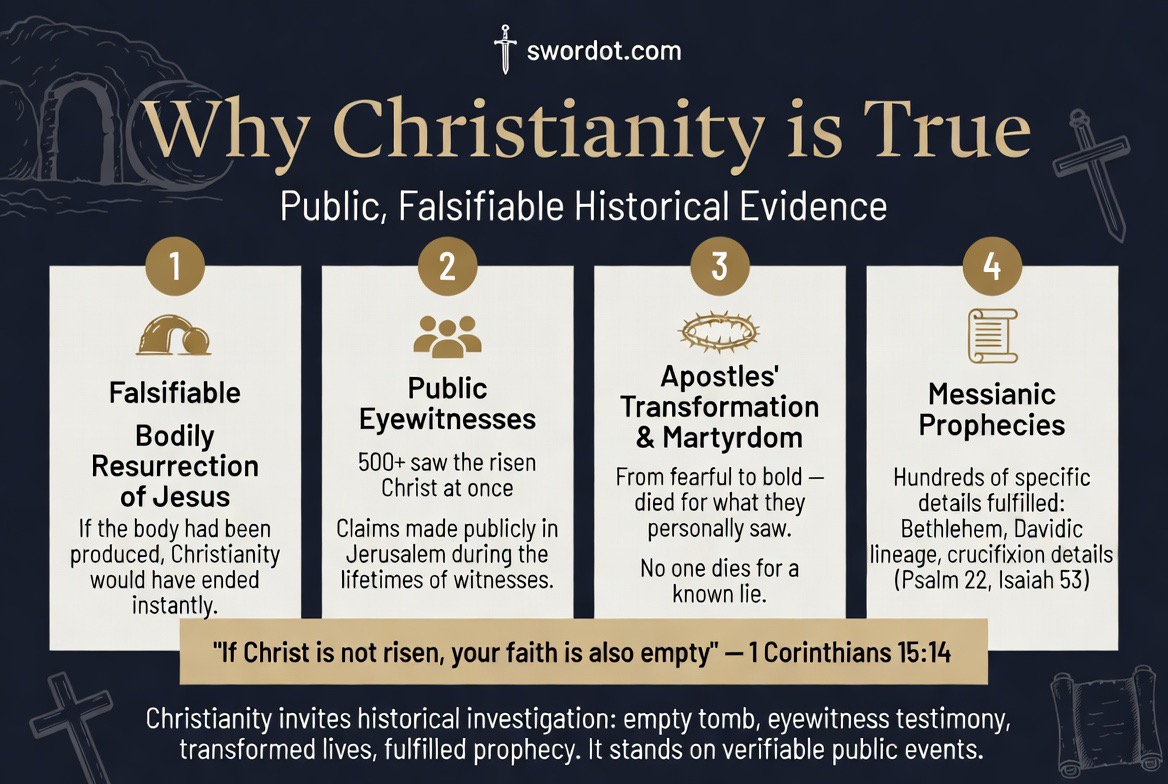
No, Christianity alone is true.
While most religions rely primarily on private mystical experiences, philosophical concepts, or the unverifiable visions of a single individual, Christianity tethers its entire validity to public, falsifiable historical events.
Four primary distinct factors separate Christianity’s claims and evidence from other belief systems.
1. It is Falsifiable by a Single Historical Event
Most world religions are built on ideologies that cannot be proven or disproven by history. For example, you cannot physically disprove the concept of reincarnation in Hinduism, nor can you historically investigate the private visions given to individual founders of other faiths.
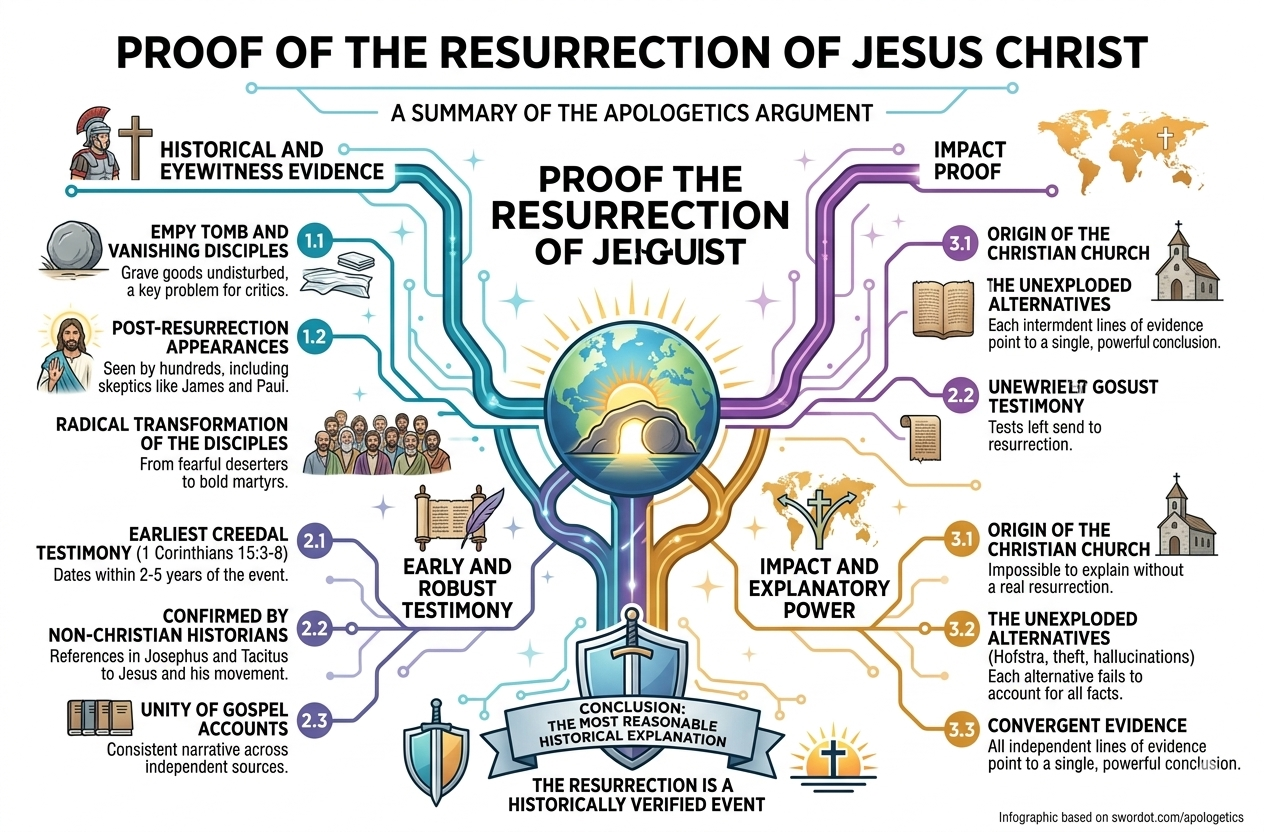
Christianity is entirely different. Its core claim is explicitly tied to a physical event in time: the bodily resurrection of Jesus Christ.
The Apostle Paul famously wrote in 1 Corinthians 15:14, “And if Christ is not risen, then our preaching is empty and your faith is also empty.”
By its own admission, if Jesus’ body had been produced by the Roman or Jewish authorities in 33 AD, Christianity would have died instantly. Christian apologists point out that the religion began in Jerusalem—the exact city where Jesus was publicly executed and buried. The early Christians were not preaching a vague, distant philosophy; they were claiming that a specific tomb just outside the city walls was empty, a claim that could easily be checked by their contemporaries.
2. The Nature of the Eyewitness Testimony
Many religions trace their origin back to a single prophet who received a private revelation (e.g., Islam, Mormonism, Buddhism). Because the revelation happened in secret, followers must trust the integrity and sanity of that lone individual.
Christianity claims its foundation rests on public miracles witnessed by many simultaneously.
- The New Testament documents record that Jesus performed his miracles, was executed, and appeared alive again in plain view of both friends and enemies.
- Paul challenged his readers by noting that Jesus appeared to more than 500 people at one time, most of whom were still alive and available to be cross-examined when the claim was written down.
- The texts were written and circulated during the lifetimes of the people who actually experienced the events, meaning any massive exaggerations or fabrications could have been readily refuted by living witnesses.
3. The Transformation and Martyrdom of the Apostles
While it is true that people across many religions die for their faith, there is a profound psychological difference between a modern martyr and the original disciples.
A modern martyr dies for what they believe to be true based on faith. The original apostles died for what they claimed to have personally seen with their own eyes.
Historically, the disciples went from being terrified, hiding in locked rooms after Jesus’ crucifixion, to boldly preaching his resurrection weeks later in the teeth of deadly opposition. Virtually all of them were systematically tortured, exiled, or executed for maintaining this specific eyewitness claim.
Psychologists and historians point out that while people will frequently die for a lie they sincerely believe is the truth, no one willingly suffers and dies for a lie they know they made up.
4. Messianic Prophecy
Christianity does not exist in a vacuum; it is the continuation of a centuries-old Jewish narrative. Long before Jesus was born, the Hebrew Scriptures (the Old Testament) laid out a highly specific profile for a coming Messiah.
Unlike the vague, poetic predictions of figures like Nostradamus, the Old Testament contains hundreds of specific details written centuries in advance. Scholars note that these prophecies include details completely outside of an individual’s personal control:
- The lineage: Being a direct descendant of Abraham, Isaac, Jacob, and King David.
- The birthplace: Specifically predicting the minor town of Bethlehem (Micah 5:2).
- The timeline: Setting a specific countdown window before the destruction of the Second Temple (Daniel 9).
- The manner of death: Psalm 22 and Isaiah 53 detailed a execution method involving the piercing of hands and feet (crucifixion) centuries before the Romans ever invented it as a form of punishment.
Summary
What fundamentally distinguishes Christianity from other religious systems is its direct invitation to academic investigation. Rather than requiring an initial blind leap of faith into a philosophical system, it presents a historical case-study, pointing back to an empty tomb, early manuscript data, verified archaeological sites, and a radical explosion of eyewitnesses who chose death over denying what they saw.
Part 2 – Buddhism
The primary historical text where Gautama Buddha explicitly addresses and denies being a god is the Doṇa Sutta, found in the Pāli Canon of Theravada Buddhism (Aṅguttara Nikāya 4.36).
In this text, a priest (brahman) named Doṇa notices the Buddha’s remarkably serene presence and unusual footprints, prompts him with a series of questions about his identity, and asks if he is a god or a supernatural being.
The Source Document
- Scripture: Aṅguttara Nikāya (The Numerical Discourses of the Buddha)
- Book/Section: Book of the Fours, Sutta 36 (AN 4.36)
- Title: Doṇa Sutta (The Discourse to Doṇa)
The Quote
In the dialogue, the priest asks the Buddha if he is a deva (the Pāli word for a god, deity, or celestial being). The Buddha directly rejects that label, alongside several other classifications, explaining that he has transcended the regular states of existence entirely.
From the translation by Bhikkhu Bodhi:
Then Doṇa approached the Blessed One and said to him:
“Could you be a deva [god], sir?”
“I will not be a deva, brahmin.”
“Could you be a gandhabba [celestial musician], sir?”
“I will not be a gandhabba, brahmin.”
“Could you be a yakkha [nature spirit/demon], sir?”
“I will not be a yakkha, brahmin.”
“Could you be a human being, sir?”
“I will not be a human being, brahmin.”
“When you are asked these questions, you say you will not be any of them. What, then, could you be, sir?”
The Buddha then explains why he rejects these categories, including that of a normal, unawakened human being:
“Brahmin, I have abandoned those taints because of which I might have become a deva; I have cut them off at the root, made them like palm stumps, obliterated them so that they are no longer subject to future arising.
I have abandoned those taints because of which I might have become a gandhabba… a yakkha… a human being…
Just as a blue, red, or white lotus flower, though born in the water and grown up in the water, rises above the water and stands unsoiled by the water, even so, though born in the world and grown up in the world, I have overcome the world and dwell unsoiled by the world.
Remember me, brahmin, as a Buddha [Awakened].”
Context of the Quote
In ancient Indian cosmology, devas (gods) were powerful, long-lived celestial beings, but they were still bound to the cycle of rebirth (samsara) and subject to spiritual ignorance.
By stating he is not a deva, the Buddha is clarifying two things:
- He is not a supreme creator or a divine being to be worshiped as a god.
- He is also not a standard, unawakened human trapped by worldly desires. He identifies simply as “Buddha,” which translates literally to “The One Who Is Awake.”
Part 3 – Islam
The Quran contains several verses that explicitly validate the divine origin of the scriptures given to the Jews and Christians—the Tawrat (Torah) and the Injeel (Gospel). Muslims are strictly commanded by the Quran to believe in these previous revelations as authentic words of God.
However, a crucial point of nuance must be made up front: Islamic theology makes a distinction between the original revelations given to Moses and Jesus, and the modern compiled books of the Bible.
While the Quran directly affirms that God revealed the true Torah and Gospel, orthodox Islamic scholarship teaches that the modern biblical text has undergone Tahreef (alteration or corruption over time) through human editing. Therefore, while Muslims believe the original messages were entirely true and from God, they do not view the modern Christian Bible as a flawless, unchanged reflection of those original revelations (Halil, 2021).
The core verses from the Quran that establish this theological link follow.
1. Surah Al-Ma’idah (5:46) – The Gospel Confirms the Torah
This verse describes Jesus being sent by God, carrying the Injeel (Gospel), which acts as a guide and explicitly confirms the truth of the Tawrat (Torah) that came before him.
The Arabic Text:
وَقَفَّيْنَا عَلَىٰ آثَارِهِم بِعِيسَى ابْنِ مَرْيَمَ مُصَدِّقًا لِّمَا بَيْنَ يَدَيْهِ مِنَ التَّوْرَاةِ ۖ وَآتَيْنَاهُ الْإِنجِيلَ فِيهِ هُدًى وَنُورٌ وَمُصَدِّقًا لِّمَا بَيْنَ يَدَيْهِ مِنَ التَّوْرَاةِ وَهُدًى وَمَوْعِظَةً لِّلْمُتَّقِينَ
The Exact Quote (Sahih International Translation):
“And We sent, following in their footsteps, Jesus, the son of Mary, confirming that which came before him of the Torah; and We gave him the Gospel, in which was guidance and light and confirming that which preceded it of the Torah as guidance and instruction for the righteous.”
2. Surah Ali ‘Imran (3:3-4) – The Quran Confirms Both
This verse frames the Quran not as a replacement that rejects the Bible, but as a continuation of the exact same divine authority, descending from the same God who sent the Torah and the Gospel.
The Arabic Text:
نَزَّلَ عَلَيْكَ الْكِتَابَ بِالْحَقِّ مُصَدِّقًا لِّمَا بَيْنَ يَدَيْهِ وَأَنزَلَ التَّوْرَاةَ وَالْإِنجِيلَ مِن قَبْلُ هُدًى لِّلنَّاسِ وَأَنزَلَ الْفُرْقَانَ
The Exact Quote (Sahih International Translation):
“He has sent down upon you, [O Muhammad], the Book in truth, confirming what was before it. And He revealed the Torah and the Gospel. Before, as guidance for the people, and He revealed the Criterion [i.e., the Quran].”
3. Surah Al-Baqarah (2:136) – The Command to Muslims
To be a Muslim, one is biblically and textually commanded by the Quran to declare belief in the books given to Abraham, Moses, Jesus, and all the previous biblical prophets, making no distinction between the validity of their original divine assignments.
The Arabic Text:
قُولُوا آمَنَّا بِاللَّهِ وَمَا أُنزِلَ إِلَيْنَا وَمَا أُنزِلَ إِلَىٰ إِبْرَاهِيمَ وَإِسْمَاعِيلَ وَإِسْحَاقَ وَيَعْقُوبَ وَالْأَسْبَاطِ وَمَا أُوتِيَ مُوسَىٰ وَعِيسَىٰ وَمَا أُوتِيَ النَّبِيُّونَ مِن رَّبِّهِمْ لَا نُفَرِّقُ بَيْنَ أَحَدٍ مِّنْهُمْ وَنَحْنُ لَهُ مُسْلِمُونَ
The Exact Quote (Sahih International Translation):
“Say, [O believers], ‘We have believed in Allah and what has been revealed to us and what was revealed to Abraham and Ishmael and Isaac and Jacob and the Descendants and what was given to Moses and Jesus and what was given to the prophets from their Lord. We make no distinction between any of them, and we are Muslims [in submission] to Him.’”
The Theological Divide
Because the Quran repeatedly uses the Arabic word Musaddiqan (meaning “confirming” or “verifying”) when pointing to previous scriptures, historical dialogue between Christians and Muslims often centers on this exact point (Bahadur, 2012).
- The Christian view: If the Quran confirms the Torah and the Gospel available during the 7th century AD (the time of Muhammad), and modern textual criticism proves our modern Bible matches those 7th-century manuscripts, then the Quran effectively validates the accuracy of the modern Bible (Khan, 2009).
- The Muslim view: Scribes and theological factions corrupted the physical delivery of those scriptures over time (Tahreef al-Lafz). Therefore, the Quran is confirming the foundational truth and divine origin of the revelations given to Moses and Jesus, but functions as the final “Criterion” (Al-Furqan) to correct the human errors, additions, and edits found in the modern Biblical text (Al Shahrani, n.d.; Halil, 2021).
References
Al Shahrani, S. A. (n.d.). Commonalities in doctrine among the biblical religions. Dialnet, 1-25.
Bahadur, P. (2012). Should the Qur’an be used in Christian witness? Journal of Adventist Mission Studies, 8(2), 203-214.
Halil, H. (2021). Reconciling the Qur’ān and the Bible: A new approach to scriptural dialogue. HTS Teologiese Studies / Theological Studies, 77(1), 1-9.
Khan, K. S. (2009). The Quran and the Bible. Al Islam, 1-6.
Cited by: 5 (Halil, 2021)
Cited by: 5 (Bahadur, 2012)
Christian Response
READ: Proof the Bible was NOT changed over time
The Bible says Jesus Christ is the ONLY path to salvation
The most definitive and famous verse stating that Jesus is the only way to salvation and heaven is John 14:6.
In this passage, Jesus is speaking directly to His disciples during the Last Supper, comforting them about His upcoming departure and preparing them for the way to heaven.
Here is the exact quote from the New King James Version (NKJV):
“Jesus said to him, ‘I am the way, the truth, and the life. No one comes to the Father except through Me.’“
Another Essential Supporting Verse, Acts 4:12
In this verse, the Apostle Peter is speaking publicly to the religious authorities in Jerusalem, making an absolute, exclusive claim about Jesus:
“Nor is there salvation in any other, for there is no other name under heaven given among men by which we must be saved.”
Part 4 – Judaism
READ: Proof Jesus Christ existed as a historical figure and was crucified
READ: Proof of the resurrection of Jesus Christ
Part 5 – Hinduism
Evaluating Hinduism through the lens of “objective evidence” requires looking at how Hindu scholars and apologists defend their faith.
Because Hinduism is structurally very different from Western religions—it is not tied to a single historical event like the Resurrection or a single prophet’s revelation—its “evidence” is anchored in ancient science, psychology, philosophy, and historical geography.
Is There Objective Evidence Hinduism is True?
When Hindu scholars argue for the truth of their tradition, they point to four primary categories of evidence.
1. Advanced Scientific and Cosmic Intuition
One of the most common arguments for the divine inspiration of the ancient Hindu texts (the Vedas and Upanishads) is their shockingly accurate description of the cosmos, written thousands of years before modern science confirmed them.
- The Age of the Universe: Most ancient religions guessed the world was a few thousand years old. Hindu texts calculate time in Kalpas (a day of Brahma). According to ancient Vedic mathematics, a Kalpa is exactly 4.32 billion years. Modern astrophysics estimates the age of the Earth at roughly 4.5 billion years—an incredibly close cosmic scale.
- The Multiverse: The Srimad Bhagavatam (6.16.37) states: “There are innumerable universes besides this one, and although they are unlimitedly large, they move about like atoms in Your mystic power.”
- Spherical Earth: Long before Europe debated the shape of the earth, Vedic literature referred to the planet as Bhugola (Bhu = Earth, Gola = Round/Sphere).
2. Historical Geography and Archaeology
Unlike purely mythical stories, the sprawling Hindu epics—the Ramayana and the Mahabharata—are set in real, verifiable geographic locations across the Indian subcontinent.
- The City of Dwarka: According to the Mahabharata, Lord Krishna ruled a magnificent, fortified golden city called Dwarka, which eventually sank into the Arabian Sea. In the 1980s, marine archaeologists discovered a massive, submerged ancient city off the coast of modern Dwarka, complete with stone walls, anchors, and architectural pillars dating back thousands of years.
- Rama’s Bridge (Adam’s Bridge): The Ramayana tells of a bridge built across the ocean by Rama’s army to rescue his wife from Sri Lanka. NASA satellite imagery reveals a 30-mile-long, underwater chain of limestone shoals connecting India and Sri Lanka exactly where the text described it.
3. The Verifiable Psychology of Yoga and Meditation
Hinduism argues that its truth can be objectively tested in the “laboratory” of your own mind. The Yoga Sutras map out human consciousness with extreme precision.
Today, modern neuroscience extensively documents that Vedic practices like Pranayama (breath control) and deep meditation physically alter the brain—shrinking the amygdala (the stress center), thickening the prefrontal cortex, and lowering cortisol. To a Hindu, this objective, biological feedback proves that the ancient rishis (sages) perfectly understood the unseen mechanics of human design.
Part 2: What Do Christians Believe the Hindu Gods Are?
Christian theology firmly rejects the validity of Hindu deities, but how Christians interpret them depends on which biblical text or theological tradition they lean on. Generally, Christian thought categorizes Hindu gods into three buckets.
1. Demonic Spirits (The Historical/Biblical View)
The most common, traditional Christian view is that the entities behind foreign idols are actual, living spiritual beings—specifically, fallen angels or demons masquerading as gods to divert worship away from Yahweh.
Christians point directly to scriptures in both the Old and New Testaments to back this up:
- Psalm 96:5 (NKJV): “For all the gods of the peoples are idols, but the Lord made the heavens.” (In the ancient Greek translation of the Old Testament, the Septuagint, the word “idols” is explicitly translated as daimonia—demons).
- 1 Corinthians 10:20 (NKJV): The Apostle Paul writes: “Rather, that the things which the Gentiles sacrifice they sacrifice to demons and not to God, and I do not want you to have fellowship with demons.”
From this perspective, the supernatural phenomena or spiritual experiences reported by practitioners of other religions are not dismissed as fake; they are viewed as real but spiritually deceptive.
2. Psychological Projections and Inanimate Idols
Another widespread Christian perspective is that Hindu gods are completely imaginary—creative human inventions born out of a fallen world trying to make sense of creation without the Bible.
This view leans heavily on passages mocking the physical nature of polytheistic idols:
- Jeremiah 10:5 (NKJV): “They are upright like a palm tree, and they cannot speak; they must be carried, because they cannot go. Do not be afraid of them, for they cannot do evil, nor can they do any good.”
- From this angle, Ganesha, Shiva, or Kali are simply cultural myths and psychological personifications of natural forces (like destruction, storms, or luck) carved into wood and stone.
3. Misdirected Longings for the True God (The Inclusivist View)
A more modern, soft theological approach (held by some Catholic and mainline Protestant theologians) views Hindu deities as a primitive, incomplete human attempt to reach the one true Creator.
This follows the logic of Paul’s sermon at Mars Hill in Acts 17, where he noticed an altar to an “Unknown God” built by Greek polytheists. Paul didn’t call them demonic; he said, “What therefore you worship as unknown, this I proclaim to you.”
In this view, when a Hindu worships Brahman (the ultimate, supreme reality behind all things in Hinduism), they are interacting with a clouded, culturally distorted intuition of the true God of the Bible, lacking the clarity that Christians believe comes only through Jesus Christ.
Christian perspectives on yoga and Hindu meditation are deeply divided. Because these practices have become heavily integrated into Western culture as secular fitness and stress-relief routines, Christians view them through drastically different lenses depending on their theological background.
Generally, Christian thought falls into three distinct camps: those who view it as spiritually dangerous, those who try to redeem it by separating the physical from the spiritual, and those who see it as a completely secular activity.
1. The Strict/Traditionalist View: A Spiritual Danger
Many conservative Protestant, Evangelical, Roman Catholic, and Eastern Orthodox theologians strongly warn Christians against practicing yoga and Hindu meditation. Their primary argument is that yoga is fundamentally inseparable from its Hindu roots.
- The Meaning of the Word: Critics point out that the word yoga literally means “to yoke” or “to unite”—specifically to yoke the individual soul (Atman) with the supreme cosmic reality (Brahman).
- Postures as Offerings: Traditional Hindu texts state that the physical postures (asanas) were not invented for physical fitness; they were designed as bodily offerings to Hindu deities. For example, the Surya Namaskar is literally a “Sun Salutation” meant to worship the solar deity Surya.
- The “Open Door” Argument: Christians in this camp believe that intentionally placing one’s body into postures dedicated to other gods opens a spiritual doorway to demonic oppression or deception, even if the person’s intent is just to stretch.
The Contrast in Meditation Styles
Traditionalist Christians also point out a massive structural contradiction between Hindu meditation and Christian meditation:
Hindu/Eastern Meditation seeks to empty the mind. The goal is to quiet thoughts, detach from reality, and realize one’s own divinity.
Christian Meditation seeks to fill the mind. Scripture commands believers to actively fill their minds with the Word of God, meditating deeply on His laws, His character, and His creation (Psalm 1:2).
2. The Integrationist View: “Holy Yoga”
A growing number of modern Christians take a middle-ground approach. They acknowledge that traditional yoga is rooted in Hinduism, but they believe the physical benefits can be redeemed and redirected toward Jesus Christ.
This has led to movements often branded as “Holy Yoga” or “PraiseMoves.”
- The Logic: These practitioners argue that God created the human body, muscles, and stretching. They believe a physical posture has no inherent spiritual power unless a person consciously gives it power.
- The Practice: In a Christianized yoga class, the traditional Sanskrit terms, chanting (like “Om”), and Hindu philosophies are entirely stripped away. Instead, instructors play worship music, recite biblical scriptures during stretching, and use the quiet meditation time at the end to pray to the God of the Bible.
3. The Secular View: It’s Just Exercise
A third, highly widespread view among mainstream, modern Christians is that Western “studio yoga” has been so thoroughly commercialized and secularized that it has lost all spiritual meaning whatsoever.
- No Spiritual Weight: Christians in this camp view a typical yoga class at a local gym the same way they view stretching before a run or doing pilates. They do not believe that doing a “downward dog” or sitting cross-legged has any more spiritual consequence than lifting a dumbbell.
- Christian Liberty: This perspective leans heavily on the Apostle Paul’s teachings regarding Christian liberty in 1 Corinthians 8. In the ancient world, people debated whether it was a sin to eat meat that had been sacrificed to pagan idols. Paul argued that since idols aren’t real gods anyway, the meat is just meat, and Christians are free to eat it with a clear conscience—unless it causes a weaker believer to stumble.
Summary of the Christian Dilemma
Ultimately, the debate among Christians boils down to a single question: Can you separate the physical movements of yoga from its historical spiritual intent?
Those who say no avoid the practice entirely to preserve their spiritual boundaries, while those who say yes utilize the physical movements for health while keeping their worship directed strictly toward Jesus.
Part 6 – Atheism
READ:
DNA sequence proves God’s existence
·
Jun 6
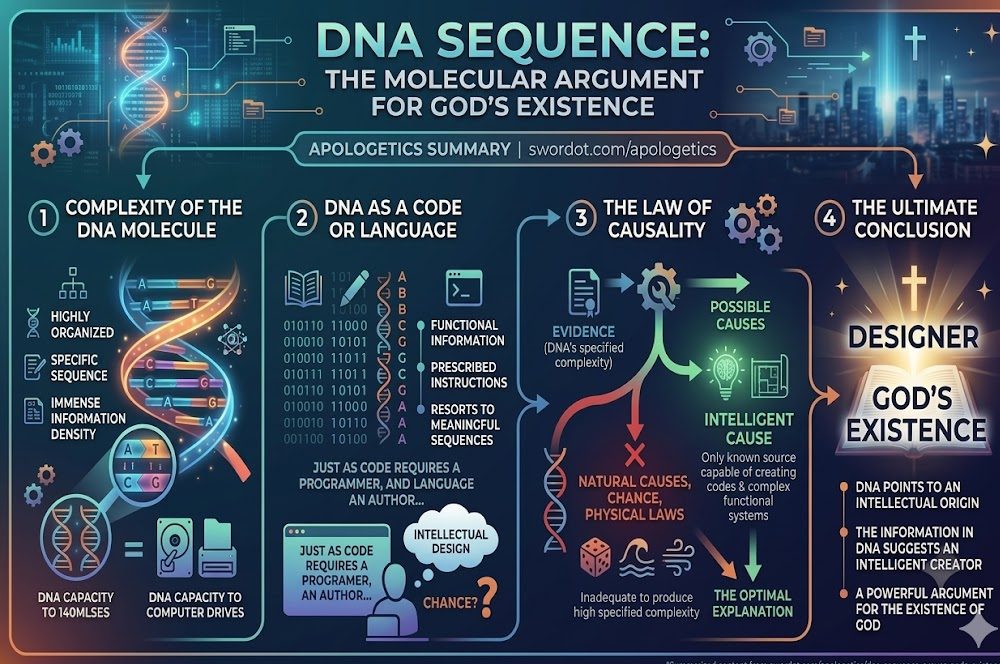
The argument that DNA points to an intelligent creator relies on the science of information. It looks at the difference between mere physical matter and the highly specific, complex instructions needed to build a living organism.