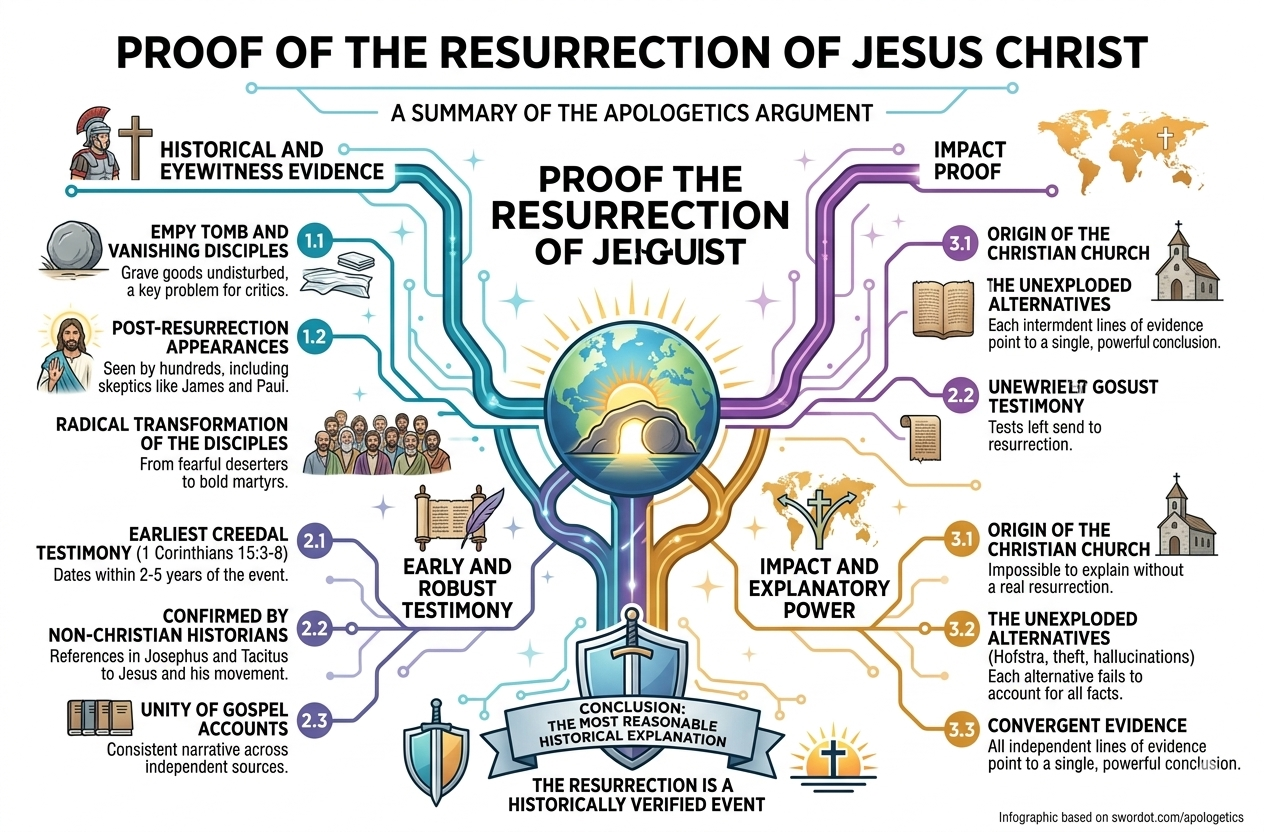
historical data—the empty tomb, the eyewitnesses, the sudden transformation of the disciples, and the rapid rise of the Church
The resurrection of Jesus Christ is the cornerstone of Christian theology. While it is ultimately a matter of faith, historians, theologians, and scholars often point to a specific cluster of historical and circumstantial evidence to argue for its validity.
Here are the primary arguments and points used to prove the resurrection:
1. The Empty Tomb
Perhaps the most foundational piece of evidence is that Jesus’ tomb was found empty just days after his public execution.
*The Roman Guard and Seal: The tomb was heavily secured by a Roman guard and a Roman seal. A stolen body would have required overpowering disciplined soldiers, which was highly unlikely for a scattered, terrified group of disciples.
*The Location: Jesus was crucified and buried in Jerusalem. If the tomb weren’t empty, the Jewish and Roman authorities could have easily produced the body to crush the early Christian movement in its tracks. They never did.
2. The Testimony of Women
In first-century Jewish and Roman culture, the testimony of women was not legally admissible in court and held very little social weight.
* All four Gospel accounts state that women (such as Mary Magdalene) were the first to discover the empty tomb and witness the risen Christ.
* If the story had been fabricated to convince the public, the writers would have chosen high-status male witnesses to make the account credible in that era. Including women as the primary witnesses points to the historical honesty of the report.
3. Eye-Witness Accounts and Post-Resurrection Appearances
The New Testament records numerous instances where Jesus appeared to people after his death, under various circumstances.
* He appeared to individuals (Mary Magdalene, Peter, James), to the twelve disciples as a group, and, according to the Apostle Paul in 1 Corinthians 15:6, to more than 500 people at one time.
* Paul noted that most of these 500 witnesses were still alive at the time of his writing, essentially challenging skeptics to go interview them.
4. The Radical Transformation of the Disciples
Following the crucifixion, the disciples were terrified, disillusioned, and hiding behind locked doors. Yet, just weeks later, they emerged as bold proclaimers of the resurrection, facing intense persecution.
*Martyrdom: Almost all of the original disciples went on to die brutal deaths (execution, crucifixion, stoning) for their claim that Jesus rose from the dead.
* People might die for a lie they *think* is the truth, but no one willingly dies for a lie they *know* they made up. Their willingness to die proves they sincerely believed they had seen the risen Christ.
5. The Conversion of Skeptics
The resurrection account is further strengthened by the sudden conversion of key figures who were previously hostile or highly skeptical.
*Paul (Saul of Tarsus): He was a violent persecutor of the early Church. After claiming to encounter the risen Jesus on the road to Damascus, he became the ultimate Christian missionary and wrote a massive portion of the New Testament.
*James, the Brother of Jesus: The Gospels note that Jesus’ own brothers did not believe in Him during His earthly ministry. Yet, after the resurrection, James became a leader of the Jerusalem church and was eventually martyred for his faith.
6. The Emergence and Growth of the Church
The Christian Church began in Jerusalem, the very city where Jesus was publicly executed.
* Despite fierce opposition from both the Jewish religious establishment and the Roman Empire, the movement exploded in growth.
* The sudden shift of thousands of orthodox Jews changing their sacred, centuries-old traditions—such as shifting the day of worship from the Sabbath (Saturday) to Sunday (the day Jesus rose)—requires a massive catalyst to explain it.
Summary: The historical data—the empty tomb, the eyewitnesses, the sudden transformation of the disciples, and the rapid rise of the Church—presents a compelling case that something monumental occurred.
Leave a Reply