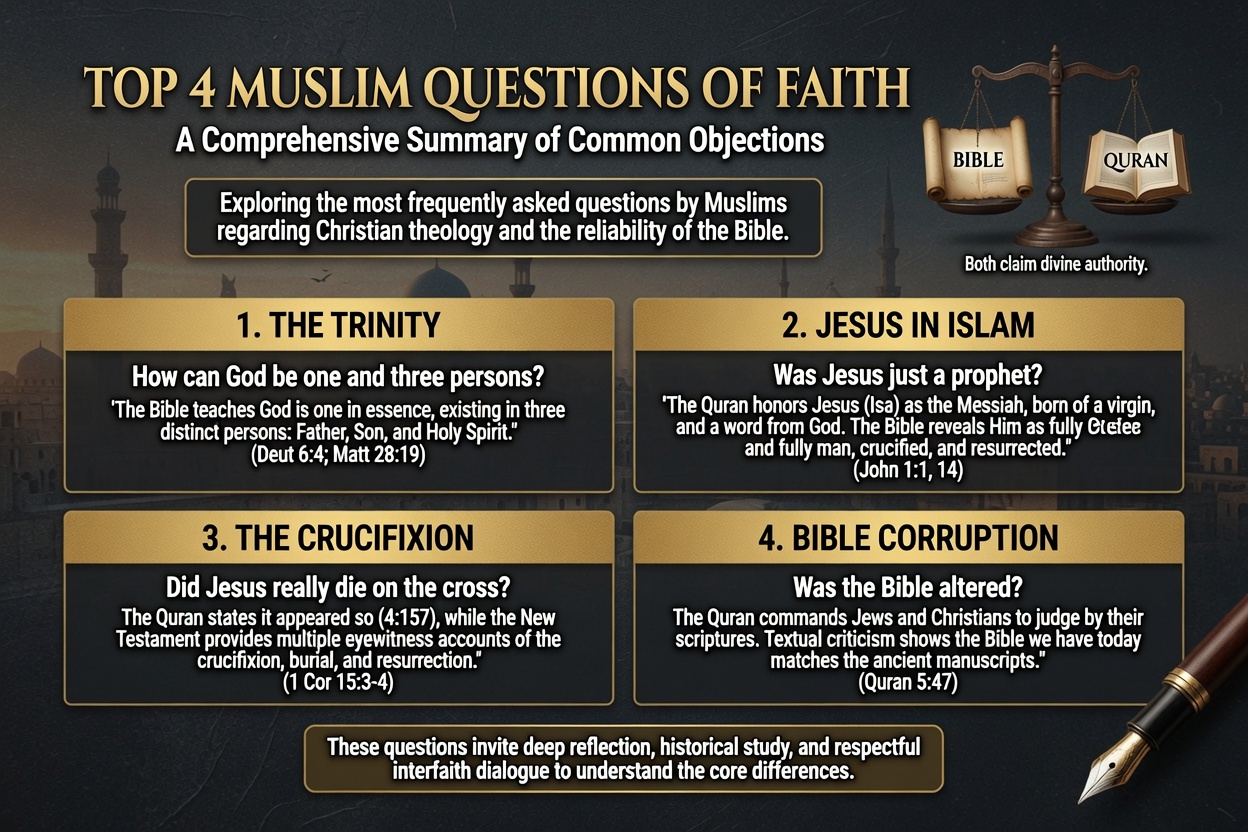
When Muslims experience a crisis of faith that leads them to explore or convert to Christianity, it usually isn’t a single question that flips a switch. Instead, it is typically a gradual shift driven by theological tensions, emotional experiences, or deep personal inquiries.
In comparative religion and ministries that work with Muslim-background believers (MBBs), several core questions and themes consistently emerge as the primary catalysts for doubt and subsequent conversion.
1. Assurance of Salvation: “How can I know for sure if God accepts me?”
In mainstream Islamic theology, salvation is ultimately dependent on the will of Allah, paired with a person’s balance of good and bad deeds. Even a highly devout Muslim cannot definitively claim they are going to Paradise (Jannah), as doing so is often seen as assuming God’s judgment.
- The Doubt: This can create a sense of spiritual anxiety or a feeling of being on a “treadmill” of religious performance, leaving people wondering if they have prayed, fasted, or repented enough.
- The Christian Alternative: Christianity introduces the concept of grace and permanent assurance through the substitutionary atonement of Jesus (the belief that Jesus paid for human sins on the cross). The shift from “I hope I have done enough” to “It has already been done for me” is often the most profound theological turning point.
2. The Nature of God: “Is God a distant master or a loving father?”
While Islamic tradition heavily emphasizes God’s mercy and compassion, the fundamental framework of the relationship between God and humanity is that of Master (Rabb) and servant/slave (Abd). Calling God “Father” is strictly rejected in Islam, as it is viewed as compromising God’s transcendent majesty.
- The Doubt: Some Muslims experience a deep longing for a personal, intimate relationship with the divine that feels difficult to achieve within a framework focused heavily on legalism and submission.
- The Christian Alternative: The Christian concept of God as an intimate, approachable Father who desires a personal relationship—and who “first loved us” while we were still sinners—appeals deeply to those seeking personal spiritual connection.
3. Historical and Moral Consistency: “Who was the Prophet Muhammad vs. Who was Jesus?”
As Muslims grow older or gain access to broader historical resources (often via the internet or diaspora communities), some begin to critically examine the Hadith (the recorded sayings and actions of Muhammad).
- The Doubt: Questions frequently arise regarding the moral complexities of Muhammad’s life, including his multiple marriages, his execution of military campaigns, or specific legal rulings. When compared to the peaceful, non-violent narrative of Jesus (Isa in Islam) presented in both the Quran and the New Testament Gospels, some find a stark contrast.
- The Christian Alternative: Because Islam already holds Jesus in incredibly high regard as a sinless, virgin-born prophet who performed miracles and ascended to heaven, exploring his life further feels natural. When Muslims read the Gospels for themselves, Jesus’s teachings on radical forgiveness, loving one’s enemies, and elevating the marginalized often present a compelling moral alternative.
4. The Integrity of Scripture: “Has the Bible actually been corrupted?”
Traditional Islamic teaching maintains that the Christian and Jewish scriptures were Tahrif (corrupted or altered over time), and that the Quran arrived to correct those errors.
- The Doubt: When textually curious Muslims begin looking into biblical archaeology, manuscript history, and textual criticism, many conclude that the New Testament has a highly reliable, deeply documented transmission history. If the Bible wasn’t corrupted, then its claims about Jesus being the Son of God who died on the cross directly contradict the Quran’s claim that he didn’t die.
- The Christian Alternative: Realizing that the historical evidence supports the early transmission of Christian texts forces a choice between the historical record of the New Testament and the theological claims of the Quran.
The Role of Dreams and Visions
Beyond intellectual questions, a unique and widely documented phenomenon among Muslims who convert to Christianity is the role of dreams and visions.
In Middle Eastern and South Asian cultures, dreams are taken very seriously as a legitimate medium for divine communication. Countless converts report having vivid, deeply peaceful dreams of a figure in white whom they intuitively understand to be Jesus, telling them to follow him or offering them comfort during a time of intense personal trial. These supernatural experiences frequently act as the catalyst that prompts them to seek out a Bible or visit a church in the first place.
Leave a Reply