DNA codes for RNA and RNA codes proteins. The DNA-to-RNA-to-protein process is a genuine code in the same fundamental sense that Morse code is a code.
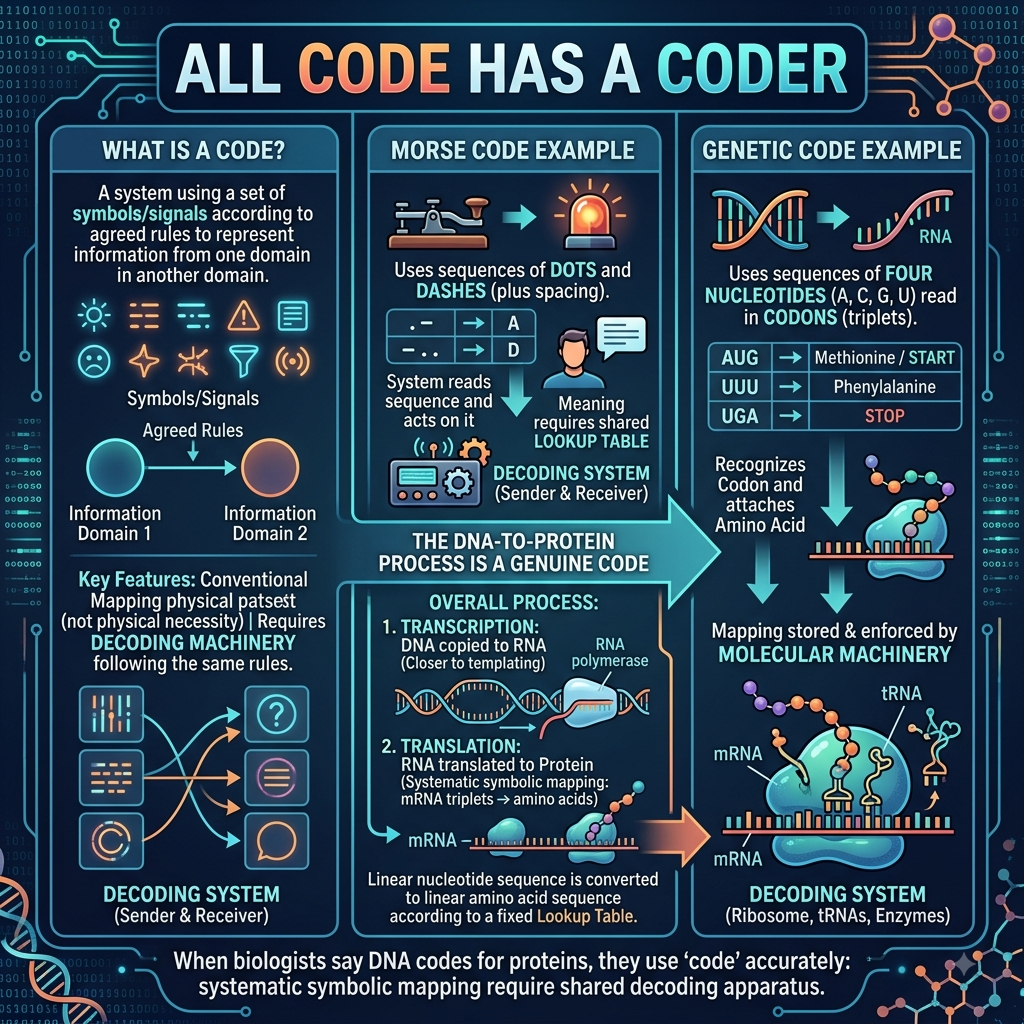
A code is a system that uses a set of symbols or signals according to agreed rules to represent information from one domain in another domain. The mapping is conventional rather than forced by simple physical necessity, and it requires a decoding machinery that follows the same rules.
Morse code takes sequences of two symbols—dot and dash, plus spacing—and maps specific combinations to letters, numbers, and punctuation. The pattern itself does not chemically or physically force a particular letter to appear. The meaning exists only because sender and receiver share the same lookup table. Without the agreed mapping and a system that can read the sequence and act on it, the dots and dashes are just pulses.
The genetic code works the same way. DNA and RNA use sequences of four nucleotide symbols (A, C, G, T/U). These are read in groups of three, called codons. Each codon is mapped to a specific amino acid or to a start or stop signal according to the genetic code. For example, AUG corresponds to methionine and also serves as the start signal, UUU corresponds to phenylalanine, and UGA is a stop signal.
This mapping is parallel to Morse code. A specific sequence of symbols stands for a specific item in another alphabet. The sequence itself does not magically become the amino acid. The cell possesses a decoding system—the ribosome, transfer RNAs, and related enzymes—that recognizes the codon and attaches the corresponding amino acid. The mapping is conventional in the same sense that Morse is conventional: there is no simple chemical reason why one particular codon must mean one particular amino acid. The mapping is stored and enforced by the molecular machinery that reads it.
The overall process has two main steps. DNA is transcribed into RNA by copying the sequence according to base-pairing rules. This step is closer to direct templating than full translation. RNA is then translated into protein. The linear sequence of nucleotides in messenger RNA is read in triplets and converted into a linear sequence of amino acids. This is the Morse-code-like step: a systematic symbolic mapping from one alphabet to a completely different alphabet.
When biologists say that DNA codes for proteins, they are using the word “code” accurately. An information-bearing sequence written in one symbolic system is converted, according to a fixed lookup table, into a sequence written in another symbolic system. Both the genetic code and Morse code are rule-based, conventional mappings from sequences of symbols in one domain to meaningful units in another domain, and both require a shared decoding apparatus to function.
Leave a Reply