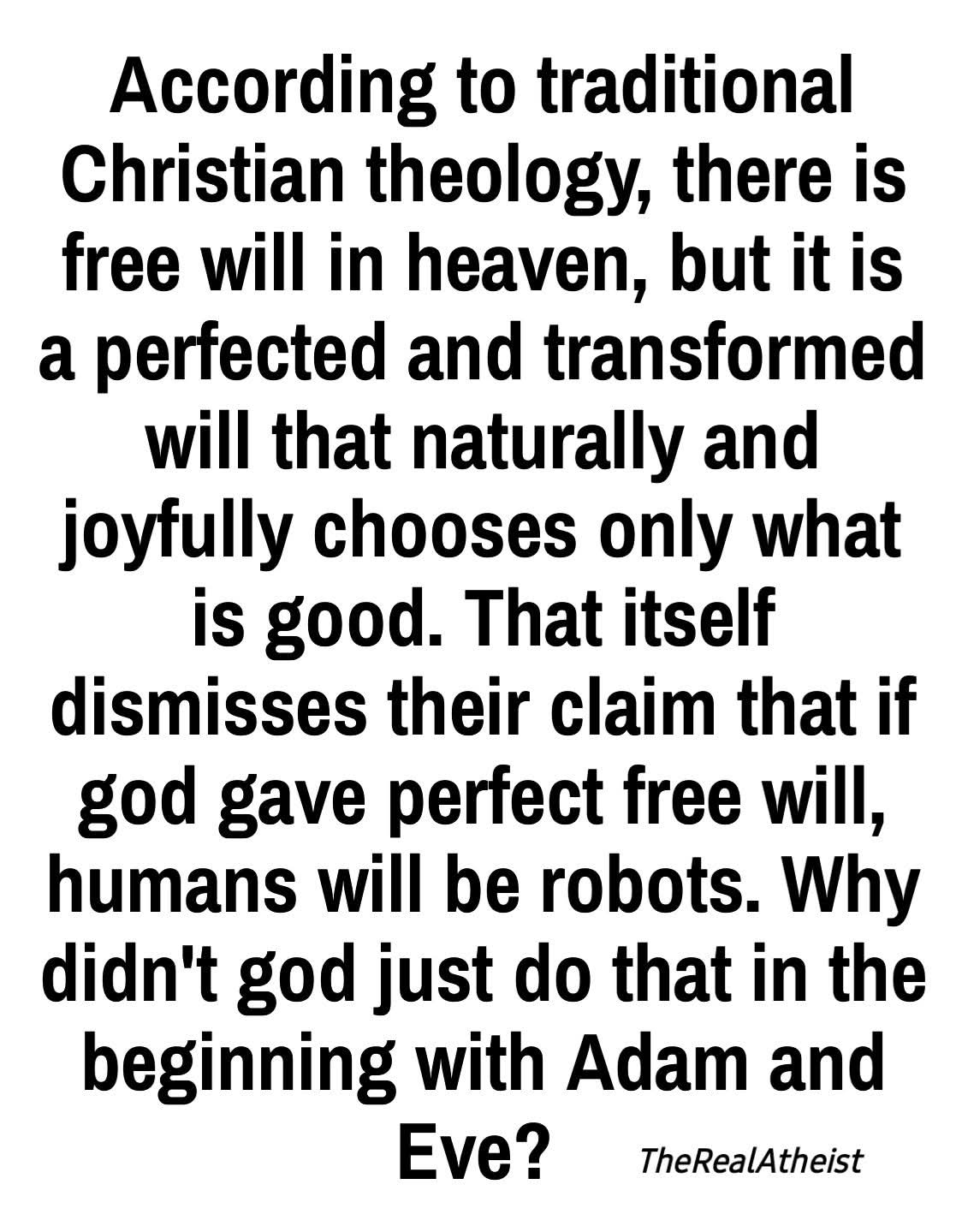
This image points out a central issue in philosophical theology—often called the Problem of Heavenly Freedom—and its first premise about traditional Christian theology is correct, even if theologian-approved answers exist for the question it raises.
Here is a breakdown of how the theology works and how Christian thinkers respond to this exact question:
1. Is the premise about Heaven true?
Yes. Major historical theologians—such as St. Augustine and Thomas Aquinas—distinguished between different stages of human freedom:
- In Eden / On Earth (Posse non peccare): Humans have the ability to choose good or evil (libertarian free will / decision-making prone to temptation).
- In Heaven (Non posse peccare): Redeemed humans retain free will, but they are “glorified.” Having seen God face-to-face (the Beatific Vision) and experienced complete transformation, their desires are fully aligned with God’s goodness. They can choose whatever they want, but they will never want to choose evil.
Because God Himself possesses free will yet cannot sin, traditional theology holds that absolute freedom doesn’t require the ability to do wrong.
2. Why didn’t God just start Adam and Eve like that?
Theologians offer a few key reasons for why Eden was created as a testing ground rather than starting straight at “Heaven mode”:
- Soul-Making & Freely Chosen Love: Many Christian philosophers (like C.S. Lewis or Alvin Plantinga) argue that genuine love and moral virtue must be freely chosen through trial and character growth. If humans were created incapable of desiring wrong from day one, their choice to love God would lack moral development.
- Heaven as a Process of Redemption: In classic Christian doctrine, heavenly perfection isn’t just an “out-of-the-box” state; it is the result of overcoming, repenting, and being transformed. Heaven is for those who choose God over self-centeredness after experiencing a world where turning away was an option.
- Knowledge vs. Ignorance: In Heaven, souls have full experiential knowledge of what sin leads to (pain, separation, evil). That knowledge permanently reshapes their perspective, whereas Adam and Eve began in innocence without that deep, tested understanding.
The Philosophical Debate
From a secular or critical standpoint, the image highlights a fair logical tension: If a state exists where free beings freely choose good 100% of the time, God could theoretically have created a world where everyone always chooses good without violating their freedom.
Whether you find the Christian counter-arguments convincing depends heavily on whether you view moral development and trial as a necessary precursor to eternal perfection.
Leave a Reply