While it is relatively rare when professional sanitation standards are followed, a massage therapist can pass pathogens to a client through direct skin-to-skin contact, contaminated linens, or respiratory droplets. The most common diseases and pathogens that can be transmitted include:
1. Bacterial Infections
Bacterial infections are the most common risk if a therapist has a cut or lesion on their hands, or if the massage table and linens were not properly sanitized between clients.
Staph Infections & MRSA:Staphylococcus aureus (including the antibiotic-resistant strain MRSA) can be transferred from the therapist’s skin or contaminated sheets into a client’s microscopic micro-tears, cuts, or open pores. It typically starts as a painful, red bump that resembles a spider bite but can rapidly progress into a severe boil or deep abscess.
Impetigo: A highly contagious bacterial skin infection that causes red sores, which can rupture, ooze for a few days, and then form a yellowish-brown crust.
Folliculitis: Inflammation of the hair follicles, often caused by bacteria. Friction from the massage along with massage oils can push bacteria deeper into the hair follicles, leading to small, itchy, pus-filled bumps.
2. Fungal Infections
Fungi thrive in warm, moist environments, making massage oils and poorly laundered linens a potential vehicle.
Ringworm (Tinea Corporis): A highly contagious superficial fungal infection that presents as a red, itchy, circular rash with a clearer center. If a therapist has it on their hands or forearms, the physical friction can easily plant the fungus onto the client’s skin.
3. Viral Infections
Viruses can be transmitted through direct skin contact or through close proximity in an enclosed room.
Warts & Plantar Warts: Caused by the Human Papillomavirus (HPV), these can be transmitted if a therapist has an active, uncovered wart on their hand and rubs it against a client’s skin.
Herpes Simplex: While type 1 (cold sores) is typically facial, a therapist with an active, weeping herpetic lesion on their hand (herpetic whitlow) can pass the virus directly to a client’s skin.
Respiratory Viruses (Flu, Colds, COVID-19): Because massage requires spending an hour or more in close, face-to-face proximity, respiratory droplets from a coughing or sneezing therapist can easily pass airborne viral illnesses to a client.
4. Parasitic Infestations
Scabies and Lice: Scabies mites and body lice require prolonged skin-to-skin contact or contact with infested linens to migrate. If the sheets are not changed and washed in hot water between clients, these parasites can be passed onto the next person using the table.
How Professional Practices Prevent This
Legitimate, licensed massage therapists follow strict sanitation laws to completely eliminate these risks:
The “Pre-Session Scan”: Therapists visually inspect their own hands and arms, as well as the client’s skin, before touching.
Strict Hand Hygiene: Washing from fingertips to elbows with warm water and soap immediately before and after every single client.
One-and-Done Linens: Sheets and face cradle covers are stripped and replaced after every single session, then washed in hot water and detergent.
Disinfection: The leather or vinyl massage table itself is wiped down with a healthcare-grade disinfectant between appointments.
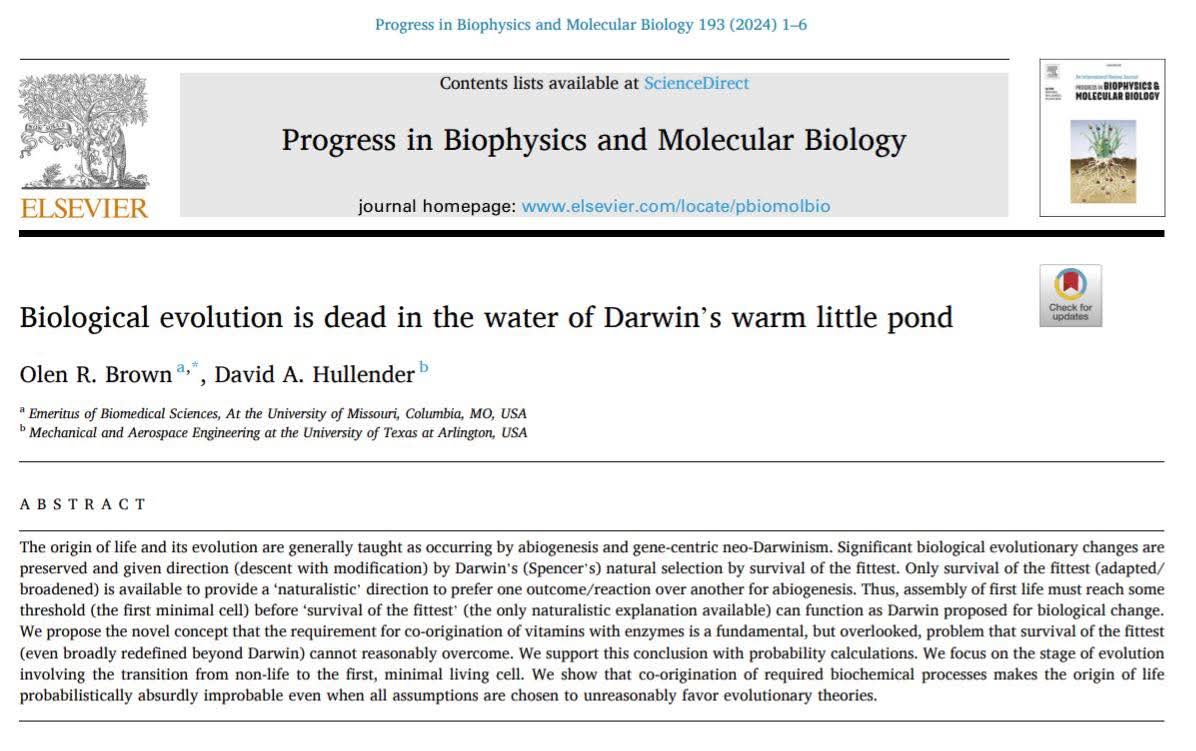
The Concept of Co-Origination: The authors introduce the novel argument that the transition from non-life to life requires multiple specific events to happen simultaneously in both time and space. The Enzyme-Vitamin Dilemma: Specifically, many essential biological enzymes cannot function without a corresponding coenzyme derived from a vitamin. For life to originate, both the complex enzyme and its required vitamin/coenzyme companion must emerge together. The Failure of Natural Selection: Because an enzyme without its cofactor (or vice versa) provides no survival advantage and represents a futile expenditure of energy, Darwinian survival of the fittest cannot select or preserve them individually. Natural selection is impotent during abiogenesis because it cannot recognize or save changes that only have future value.
Defining the Minimal Living Cell
To evaluate the likelihood of abiogenesis, the authors focus on the threshold of a modern minimal cell model, referencing Mycoplasma genitalium and the synthetic JCVI-syn3.0. For their calculations, they isolate a highly streamlined system consisting of 8 core biochemical processes (such as protein, DNA, RNA, and lipid synthesis), which require a total of 70 unique enzymes and 10 unique coenzymes.
Probability and Statistical Impossibility
Generous Assumptions: To test mainstream evolutionary doctrine, the authors choose highly generous, unrealistically favorable parameters—assuming a warm little pond already abiotically stocked with all required amino acids, nucleotides, lipids, and an energy source (ATP).
The Mathematical Verdict: Using mathematical models for an uninterrupted sequence of events required to build this minimal metabolic ensemble, the authors compute total probabilities based on varying ratios of generating an enzyme versus a coenzyme. Even under the most absurdly optimistic assumptions, the probability ranges from 1 in 10^227 down to 1 in 10^1137. The authors note that an exponent of 80 is sufficient to account for all particles in the known universe, rendering the naturalistic assembly of first life statistically impossible and absurdly improbable.
Conclusion
The authors conclude that mainstream biology must reboot its approach to evolutionary theory. They assert that time alone cannot serve as the hero of abiogenesis, and that the necessity for the co-origination of essential components deals a fatal blow to the concept of survival of the fittest as a mechanism for explaining the origin of life.
“Published Journal Article from Progress in Biophysics and Molecular Biology
Conclusions Calculated probabilities for the origin of life are absurdly improbable even when highly favorable assumptions are made. This agrees with the use of ‘absurd’ for probability statements by Eigen and that Wald (1954) found it necessary to use ‘miracles’ to justify his use of ‘impossible becomes possible’. The origin of life and its evolution cannot be ‘explained’ by a near-infinite sequence of minute changes given direction via selection by survival of the fittest. The death knell is the necessity for co-origination in space and in time, in one genome or perhaps two contiguous genomes (or whatever assumed the function before there was a genome) of all the structures and functions that are essential for life. The calculated probabilities reach absurd values as low as 1 chance in 10^1137 trials and rise to only one chance in 10^227 trials when one allows a coenzyme and an enzyme to be repeatedly created with an average absurdly high probability, respectively, of 1 in 10 to 1 in 1000 random trials. The exponents 1137 and 227 can be compared with exponents required for other large numbers: an exponent of 11 suffices for the number of stars in our galaxy and it is estimated that the exponent 80 is sufficient for all the particles in the universe. ‘Science’ has spent more than a century and a half worshiping at the altar of an idea that has few scientific clothes (surely no ensemble); we are on a yellow brick road leading only to a wonderful wizard. Like Alice we are not in Kansas anymore; natural selection is not natural but is given powers that are magical and miraculous. Natural selection, survival of the fittest and time are the great pretenders—they pretend we are doing well, but they pretend too much. We must reboot the computer called biological evolution. Time (even billions of years) is not the hero of the plot; however, for scientific understanding of biological evolution, time is of the essence.”
Citation: Contents lists available at ScienceDirect Progress in Biophysics and Molecular Biology journal homepage: www.elsevier.com/locate/pbiomolbio
Biological evolution is dead in the water of Darwin’s warm little pond Olen R. Brown a,* , David A. Hullender b a Emeritus of Biomedical Sciences, At the University of Missouri, Columbia, MO, USA b Mechanical and Aerospace Engineering at the University of Texas at Arlington, USA
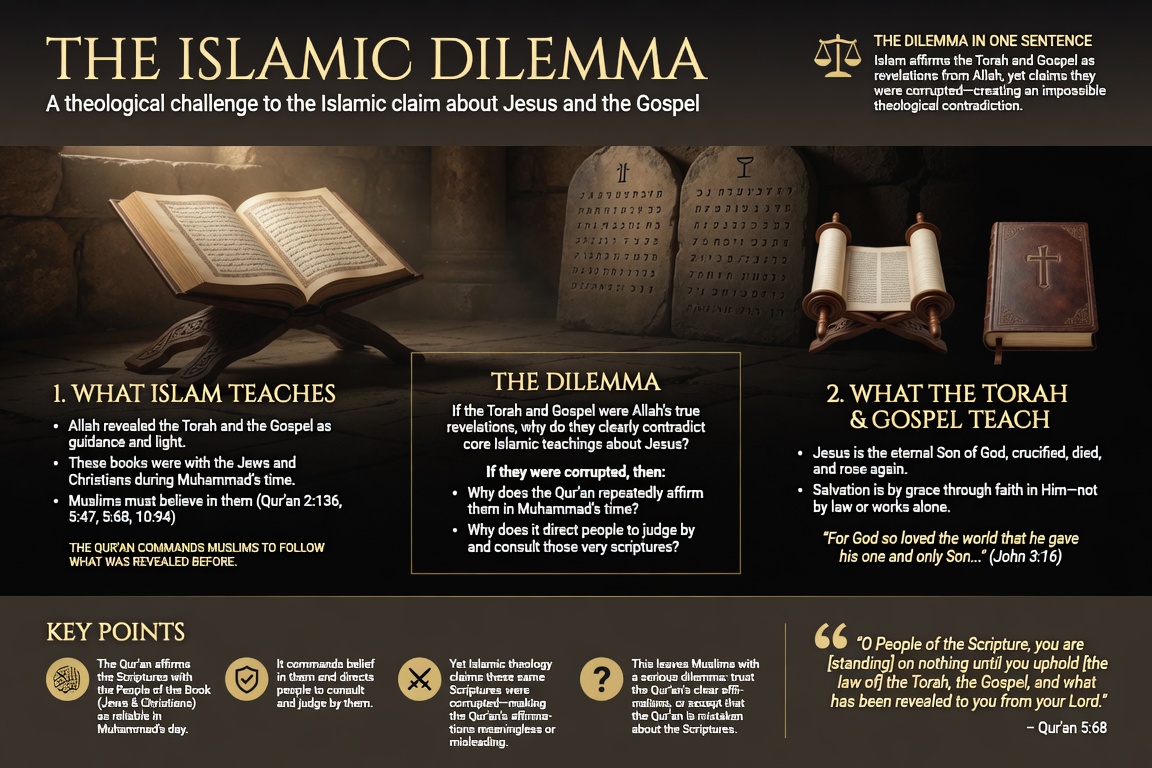
The Islamic Dilemma is one of the most intense points of debate between Christian and Muslim scholars, because it forces a collision between 4th-century physical manuscripts and 7th-century theology. To understand why this causes such deep doubt for some, we have to look at the three facts you just laid out, and how both sides try to resolve them.
Fact 1: The Quran Affirms the Prior Scriptures
The Quran does not explicitly say “the Bible is a fake book.” In fact, it commands 7th-century Christians and Jews to look to their own scriptures for guidance:
Surah 5:47:“Let the People of the Gospel judge by what Allah has revealed therein.”
Surah 10:94: Allah tells Muhammad that if he is ever in doubt about his own revelation, he should “ask those who have been reading the Scripture before you.” The text uses the Arabic phrase ma’ahum (“with them”), strongly implying that the Christians living during Muhammad’s life had the authentic text in their hands.
Fact 2: The Physical Chain of Manuscripts
This is where history comes in. We have thousands of ancient Bible manuscripts, including massive, complete Bibles like the Codex Sinaiticus and Codex Vaticanus, which were written in the 300s CE—roughly 300 years before Islam ever began. Because we can compare copies from Egypt, Rome, Syria, and Greece, historians know exactly what the Bible said in the 7th century when Muhammad was alive. Those 7th-century Bibles are effectively identical to the Bibles we read today. They explicitly state that Jesus is the Son of God, that he died on a cross, and that he rose from the dead.
Fact 3: The Contradiction
Here is the core issue:
The Quran says the Gospel with the 7th-century Christians is true.
Physical history shows the Gospel with the 7th-century Christians claimed Jesus died on the cross as the Son of God.
The Quran explicitly denies that Jesus is the Son of God or that he died on the cross (Surah 4:157). If a Muslim accepts the historical integrity of the Bible manuscripts, they run into a wall: the Bible the Quran affirms directly contradicts the Quran.
How Islamic Scholars Respond
To resolve this, Islamic apologists and scholars generally rely on two main arguments:
1. The “Lost Original Book” Theory
Mainstream Islamic theology argues that the Injil (the Gospel) mentioned in the Quran is not the New Testament we have today (Matthew, Mark, Luke, and John). Instead, they believe the Injil was a single, literal book given directly to Jesus by God—much like the Quran was given to Muhammad. In this view, Jesus’s actual book was lost or severely corrupted by his followers very early on, and the four Gospels we have today are just human biographies written later, heavily altered by the Apostle Paul to introduce the idea of Jesus’s divinity.
2. Textual vs. Oral Corruption (Tahrif)
When the Quran accuses Jewish or Christian scholars of corrupting scripture, Islamic scholars point out that it often uses phrases like “they distort the Book with their tongues” (Surah 3:78). They argue that Tahrif (corruption) originally meant misinterpretation or hiding verses, rather than rewriting the physical ink on the pages. However, as the physical manuscript evidence became undeniable over the last few centuries, the mainstream Muslim view shifted to insisting that the actual text of the modern Bible must have been altered from its original form.
Why This Causes Doubt
For a Muslim who loves history and archaeology, the “Lost Original Book” theory can feel like a tough pill to swallow. It requires believing that a completely pure, original book of Jesus existed, but vanished from the face of the earth leaving absolutely zero archaeological or historical footprints—and that God allowed His own revelation to be entirely corrupted until the Quran arrived 600 years later. When a Muslim realizes that the Bibles in Muhammad’s day said the exact same things our Bibles say today, it forces a profound theological choice: either the manuscript timeline is wrong, or the Quran’s understanding of what the Christians possessed is wrong. This realization is frequently the exact moment a Muslim’s faith in Islam begins to unravel.
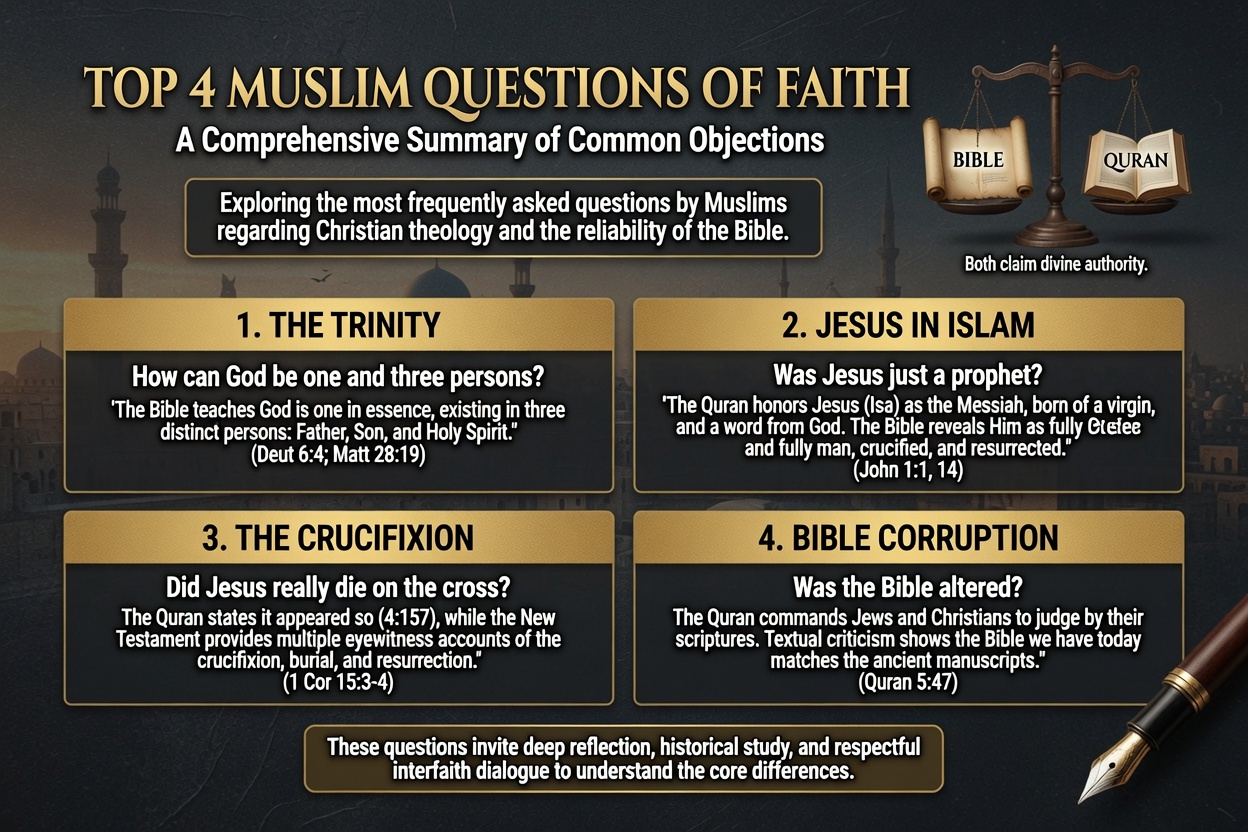
When Muslims experience a crisis of faith that leads them to explore or convert to Christianity, it usually isn’t a single question that flips a switch. Instead, it is typically a gradual shift driven by theological tensions, emotional experiences, or deep personal inquiries. In comparative religion and ministries that work with Muslim-background believers (MBBs), several core questions and themes consistently emerge as the primary catalysts for doubt and subsequent conversion.
1. Assurance of Salvation: “How can I know for sure if God accepts me?”
In mainstream Islamic theology, salvation is ultimately dependent on the will of Allah, paired with a person’s balance of good and bad deeds. Even a highly devout Muslim cannot definitively claim they are going to Paradise (Jannah), as doing so is often seen as assuming God’s judgment.
The Doubt: This can create a sense of spiritual anxiety or a feeling of being on a “treadmill” of religious performance, leaving people wondering if they have prayed, fasted, or repented enough.
The Christian Alternative: Christianity introduces the concept of grace and permanent assurance through the substitutionary atonement of Jesus (the belief that Jesus paid for human sins on the cross). The shift from “I hope I have done enough” to “It has already been done for me” is often the most profound theological turning point.
2. The Nature of God: “Is God a distant master or a loving father?”
While Islamic tradition heavily emphasizes God’s mercy and compassion, the fundamental framework of the relationship between God and humanity is that of Master (Rabb) and servant/slave (Abd). Calling God “Father” is strictly rejected in Islam, as it is viewed as compromising God’s transcendent majesty.
The Doubt: Some Muslims experience a deep longing for a personal, intimate relationship with the divine that feels difficult to achieve within a framework focused heavily on legalism and submission.
The Christian Alternative: The Christian concept of God as an intimate, approachable Father who desires a personal relationship—and who “first loved us” while we were still sinners—appeals deeply to those seeking personal spiritual connection.
3. Historical and Moral Consistency: “Who was the Prophet Muhammad vs. Who was Jesus?”
As Muslims grow older or gain access to broader historical resources (often via the internet or diaspora communities), some begin to critically examine the Hadith (the recorded sayings and actions of Muhammad).
The Doubt: Questions frequently arise regarding the moral complexities of Muhammad’s life, including his multiple marriages, his execution of military campaigns, or specific legal rulings. When compared to the peaceful, non-violent narrative of Jesus (Isa in Islam) presented in both the Quran and the New Testament Gospels, some find a stark contrast.
The Christian Alternative: Because Islam already holds Jesus in incredibly high regard as a sinless, virgin-born prophet who performed miracles and ascended to heaven, exploring his life further feels natural. When Muslims read the Gospels for themselves, Jesus’s teachings on radical forgiveness, loving one’s enemies, and elevating the marginalized often present a compelling moral alternative.
4. The Integrity of Scripture: “Has the Bible actually been corrupted?”
Traditional Islamic teaching maintains that the Christian and Jewish scriptures were Tahrif (corrupted or altered over time), and that the Quran arrived to correct those errors.
The Doubt: When textually curious Muslims begin looking into biblical archaeology, manuscript history, and textual criticism, many conclude that the New Testament has a highly reliable, deeply documented transmission history. If the Bible wasn’t corrupted, then its claims about Jesus being the Son of God who died on the cross directly contradict the Quran’s claim that he didn’t die.
The Christian Alternative: Realizing that the historical evidence supports the early transmission of Christian texts forces a choice between the historical record of the New Testament and the theological claims of the Quran.
The Role of Dreams and Visions
Beyond intellectual questions, a unique and widely documented phenomenon among Muslims who convert to Christianity is the role of dreams and visions. In Middle Eastern and South Asian cultures, dreams are taken very seriously as a legitimate medium for divine communication. Countless converts report having vivid, deeply peaceful dreams of a figure in white whom they intuitively understand to be Jesus, telling them to follow him or offering them comfort during a time of intense personal trial. These supernatural experiences frequently act as the catalyst that prompts them to seek out a Bible or visit a church in the first place.
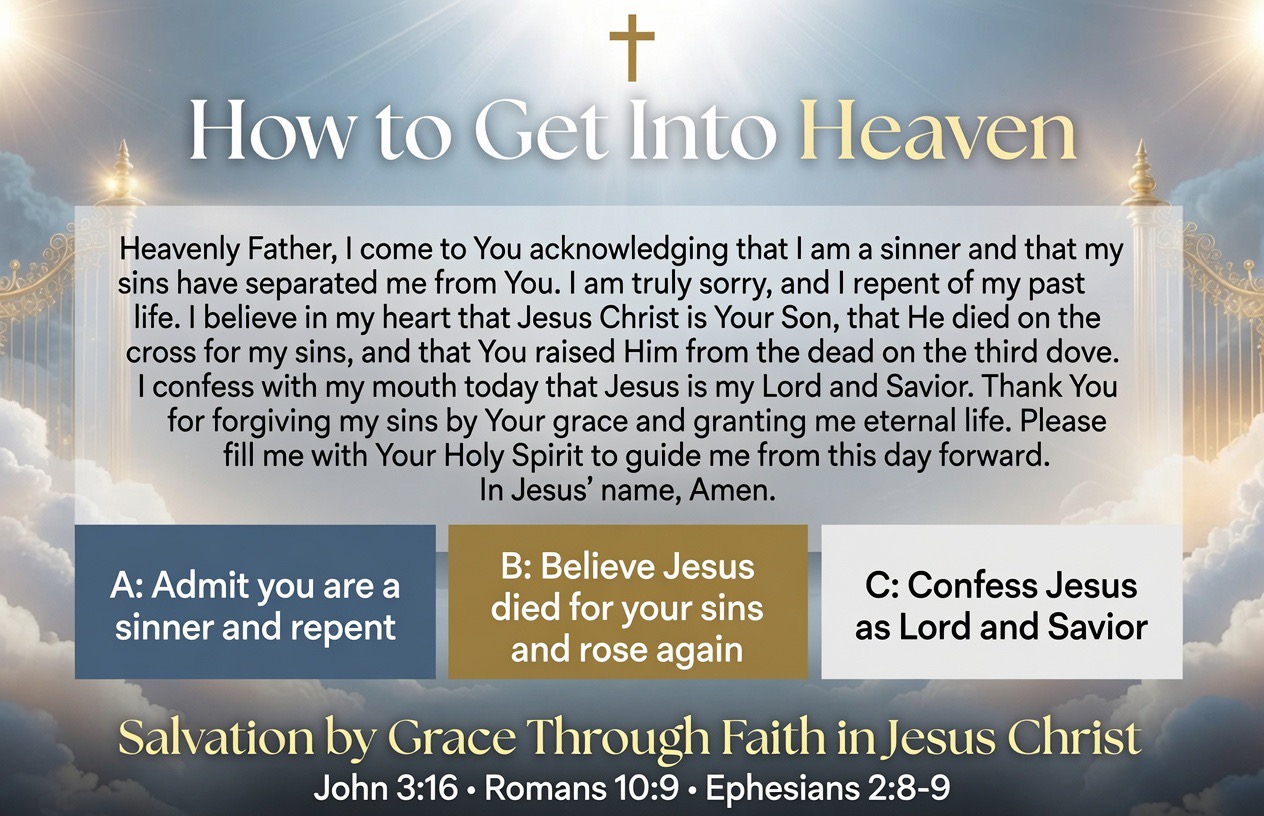
I come to You acknowledging that I am a sinner and that my sins have separated me from You. I am truly sorry, and I repent of my past life.
I believe in my heart that Jesus Christ is Your Son, that He died on the cross for my sins, and that You raised Him from the dead on the third day. I confess with my mouth today that Jesus is my Lord and Savior.
Thank You for forgiving my sins by Your grace and granting me eternal life. Please fill me with Your Holy Spirit to guide me from this day forward.
When scientists or the public talk about “macroevolution” (large-scale evolutionary changes that occur over geological time, resulting in the formation of new species, genera, or families), they are often looking at two different things:
The overall fact of common descent, which is overwhelmingly proven by multiple independent lines of evidence.
The specific, step-by-step mechanical pathways of how every single complex trait or lineage split occurred, which is where the active, unproven frontiers of science lie. There is nothing in macroevolution that has been shown to be mathematically, physically, or biologically impossible. However, there are massive gaps in our knowledge, highly debated mechanisms, and complex biological transitions that we haven’t fully “proven” or mapped out yet. Here are the major areas where macroevolutionary science faces its biggest questions, missing pieces, and current limitations.
1. The Ultimate Frontier: The Origin of Life (Abiogenesis)
While technically a distinct field from evolution—evolution explains how life changes once it exists, while abiogenesis explains how life started—they are deeply intertwined in the public mind. We currently do not know how the very first self-replicating, living cellular structures arose from non-living chemicals.
What is missing: While we have proven that the building blocks of life (amino acids, RNA bases) can form spontaneously in primordial conditions, we have not yet proven the exact chemical pathway that links these loose molecules into a functioning, metabolizing protocell.
Does it look impossible? No. Fields like RNA-world research and hydrothermal vent chemistry show plausible pathways, but we currently lack a definitive, proven “recipe.”
2. “The Missing Steps” in the Fossil Record (Punctuated Equilibrium)
One of the oldest criticisms of macroevolution is the apparent lack of transitional fossils for certain species. If evolution is a slow, gradual accumulation of tiny changes, the fossil record should look like a perfectly smooth, continuous gradient. Instead, it often looks like a species appears suddenly, stays the same for millions of years, and then disappears.
The Scientific Explanation: Evolutionary biologists Stephen Jay Gould and Niles Eldredge proposed Punctuated Equilibrium. They argued that evolution happens rapidly in small, isolated populations (where transitions are rarely preserved as fossils) followed by long periods of stability.
The Unproven Element: Because fossilization is incredibly rare, we are missing the exact, generation-by-generation physical transitions for many lineages. We have spectacular transitional sequences for whales, horses, and birds, but for many other groups, we only have the “before” and “after” snapshots.
3. Explaining Sudden Bursts of Diversity (The Cambrian Explosion)
Roughly 540 million years ago, a massive variety of complex, multicellular animal phyla appeared in the fossil record in a relatively short geological window (around 20 million years). This is known as the Cambrian Explosion.
The Challenge: To some, the sudden appearance of radically different body plans (arthropods, mollusks, chordates) looked “impossible” under standard, slow Darwinian evolution.
What we are still proving: Scientists are still trying to prove which trigger was the primary driver. Was it an environmental trigger (a sudden rise in atmospheric oxygen), a genetic trigger (the evolution of Hox genes that dictate body layouts), or an ecological trigger (the invention of eyes and active predation)? It remains one of macroevolution’s most intensely studied puzzles.
4. Gaps in Mapping the “Genotype-to-Phenotype” Map
Thanks to modern genetics, we can compare the DNA of a chimpanzee and a human, or a land mammal and a whale, and pinpoint the genetic differences. However, knowing which genes are different is not the same as proving how those genetic changes physically altered the animal during its embryonic development.
The Frontier: The field of Evolutionary Developmental Biology (Evo-Devo) is currently trying to map out exactly how small mutations in “switch” genes (regulatory DNA) translate into massive physical changes in a growing embryo.
The Current State: We understand the broad strokes (like how the electric eel repurposed its muscle genes), but for the vast majority of complex evolutionary traits, we cannot yet write out the exact, definitive step-by-step genetic script that caused the structural transformation.
Why “Unproven” Does Not Mean “Impossible”
In science, there is a strict difference between an unsolved puzzle and an impossibility. Whenever a trait looks “irreducibly complex” (meaning it seems impossible for it to have evolved because removing any one part makes the whole system fail), closer inspection usually reveals a natural path. Just like the electric eel’s weapon started as a weak navigation tool, complex structures like the human eye or the blood-clotting cascade have been proven to develop through co-option (taking an old tool and using it for a new job) and gradual refinement. Macroevolutionary scientists do not claim to have a complete, step-by-step blueprint of every biological event over the last 3.8 billion years. What they do have is a robust framework where every new fossil, genetic sequence, and geographical discovery continues to validate the core mechanism of natural selection.
In this video, speaker Wes Huff outlines 6 reasons why he remains a convictional Protestant rather than a Roman Catholic. He frames his arguments around the core concept of sufficiency—arguing that while Catholics agree many of these components are necessary, Protestants believe they are entirely sufficient on their own.
Here is a summary of the main points he makes, organized by the reasons he presents, along with every Bible verse he quotes.
1. The Sufficiency of Scripture
The Protestant View: Scripture is unique because it is the literal speech of God. It functions as the ultimate and infallible rule for faith and practice. While church tradition has a “voice,” Scripture has the final “veto” (a ministerial authority vs. Rome’s magisterial authority).
The Catholic Contrast: The Council of Trent established a dual-source framework, affirming that infallible truth and the rule of salvation exist in both written Scripture and unwritten church traditions.
2. The Sufficiency of Faith
The Protestant View: Justification is a definitive, judicial moment in time where God pronounces a believer righteous based entirely on faith in Jesus Christ, excluding any human deeds or religious rituals.
The Catholic Contrast: Justification is viewed as a lifelong, progressive process. Grace is infused into the believer through sacraments (baptism, mass, etc.), making salvation a cooperative effort between God’s grace and human effort.
Verses Quoted:
Hebrews 11:6 & Romans 8:8 [00:09:49] – Used to argue that humans in their fallen state possess no inherent capacity to do works that please God or contribute to their own salvation.
Romans 8:1 [00:12:15] – Quoted to emphasize the security and finality of Christ’s work: “There is therefore now no condemnation for those who are in Christ Jesus.”
3. The Sufficiency of Grace
The Protestant View: Grace is God’s sovereign, transformative power that saves entirely on its own, independent of human merit or organizational mediation.
The Catholic Contrast: Grace is a substance dispensed through the church’s channels that enables salvation but requires human ascent and cooperation to be completed.
Verses Quoted:
Romans 11:6 [00:13:38] – Points out that if salvation is by grace, it cannot simultaneously rest on works, otherwise grace ceases to be grace.
2 Corinthians 12:9 [00:13:58] – Highlights the completeness of God’s grace: “My grace is sufficient for you.”
2 Timothy 1:9 [00:14:06] – Used to show that salvation is based on God’s own purpose and grace given before time began, not human cooperation.
4. The Papacy
The Protestant View: The office of the Pope is not biblically or historically supported. Historically, a singular ruling Bishop of Rome did not exist in the 1st or early 2nd centuries; early church letters point to a collegiate leadership of multiple elders.
The Catholic Contrast: The Pope is the Bishop of Rome, the successor of Peter, and the supreme earthly vicar of Christ holding universal jurisdiction over the Church.
Verses Quoted:
Matthew 16:18 [00:14:57] – “And I tell you, you are Peter, and on this rock I will build my church…” Huff reads the Greek text on-screen [00:16:51] to argue that Jesus was building the church on Peter’s confession of Christ’s identity, not on Peter’s person or a line of papal successors.
5. Prayer to the Saints
The Protestant View: Throughout the Bible, prayer is exclusively a dialogue addressed to the divine and is fundamentally an act of worship. Requesting the dead to intercede breaks down scripturally and historically degrades into superstition.
The Catholic Contrast: Distinction is made between latria (worship due to God alone) and dulia (veneration given to saints). Asking a saint in heaven to pray for you is viewed as no different than asking a friend on earth to pray for you.
Verses Quoted:
Romans 1:7 [00:21:56] & 1 Corinthians 1:2 [00:22:05] – Quoted to demonstrate that the New Testament explicitly labels all living believers as “saints,” rather than restricting the title to an elite, canonized group in heaven.
6. The Sacrifice of the Mass
The Protestant View: The Lord’s Table is a celebratory remembrance of a finished event, moving “heavenly downward” as a gift of grace to the church. The author of Hebrews clarifies that Christ’s sacrifice was a final, non-repeatable event.
The Catholic Contrast: The Mass is a literal, propitiatory (wrath-appeasing) sacrifice. It is an “unbloody” re-presentation where the priest offers Christ up to God the Father (“earthly upward”) for the ongoing remission of sins.
Scripture Referenced:
Hebrews 9 & 10 [00:30:02] – Cited broadly to contrast the repeatable Old Covenant sacrifices with the single, “once-for-all” sacrifice of Jesus on the cross.
Additional Point: The “Unchanged” Church & Justification
Huff concludes by noting that church history reveals significant doctrinal developments over time—meaning Rome’s claim of being an “unchanged church” does not hold up under scrutiny. He points out that medieval Catholicism firmly taught that submission to the Pope was entirely necessary for salvation (Unam Sanctam), whereas modern Vatican II theology states that non-Catholics (and even non-Christians like Muslims) can be saved.
He provides an extensive list of verses to wrap up his defense of the Protestant view of forensic justification (being declared righteous rather than made righteous):
Romans 4:4-5 [00:37:47] – Abraham’s faith, not his labor, was counted as righteousness.
Romans 4:25 & 5:1 [00:37:56] – Connects resurrection to justification and peace with God.
Romans 8:33 [00:38:07] – Identifies God as the ultimate entity who justifies.
Romans 4:9(likely intending Romans 5:9) [00:38:17] – Justification through Christ’s blood saves us from future wrath.
Galatians 2:16 [00:38:36] – Explicitly states a person is not justified by works of the law, but through faith.
Romans 3:20-24 & 3:28 [00:38:46] – No one achieves righteousness through law-keeping; justification is a free gift of grace apart from works.
Can Catholics be Christians?
Yes, Huff emphasizes that both Martin Luther and John Calvin explicitly affirmed that true Christians exist within the Roman Catholic Church. However, his final stance is that a Catholic who is truly saved is saved in spite of official Roman Catholic dogma, not because of it.
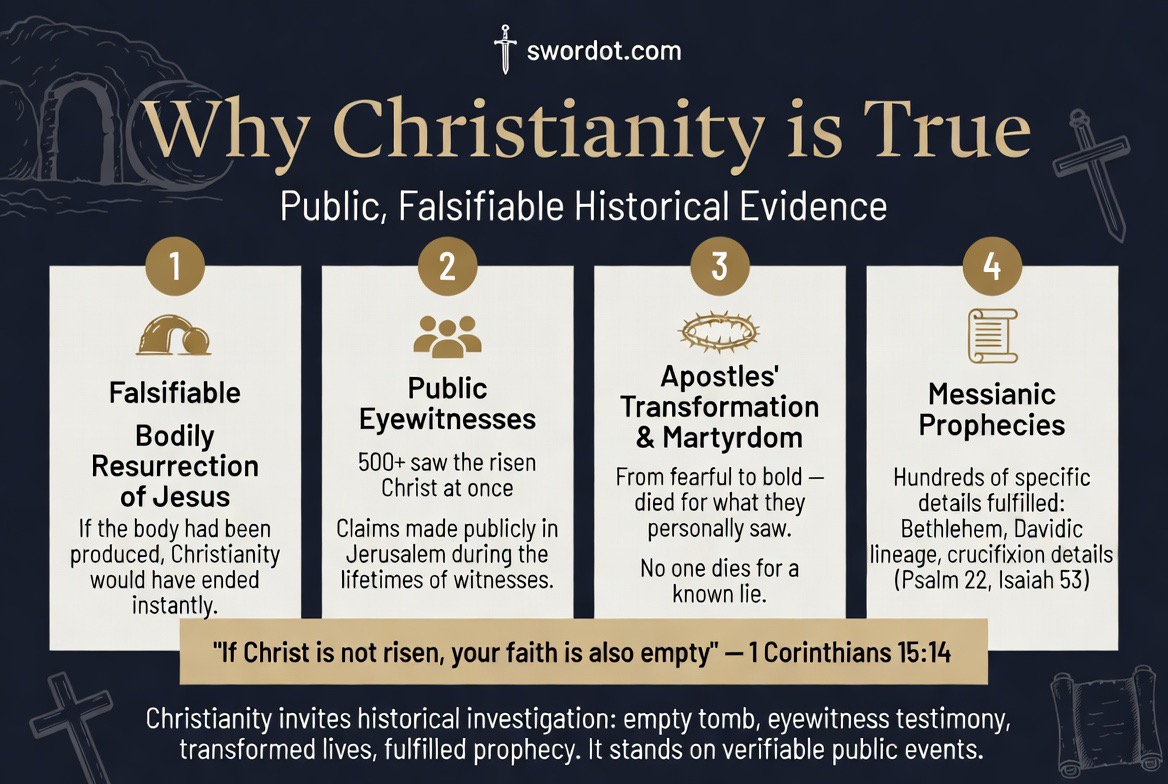
While most religions rely primarily on private mystical experiences, philosophical concepts, or the unverifiable visions of a single individual, Christianity tethers its entire validity to public, falsifiable historical events.
Four primary distinct factors separate Christianity’s claims and evidence from other belief systems.
1. It is Falsifiable by a Single Historical Event
Most world religions are built on ideologies that cannot be proven or disproven by history. For example, you cannot physically disprove the concept of reincarnation in Hinduism, nor can you historically investigate the private visions given to individual founders of other faiths.
Christianity is entirely different. Its core claim is explicitly tied to a physical event in time: the bodily resurrection of Jesus Christ.
The Apostle Paul famously wrote in 1 Corinthians 15:14, “And if Christ is not risen, then our preaching is empty and your faith is also empty.”
By its own admission, if Jesus’ body had been produced by the Roman or Jewish authorities in 33 AD, Christianity would have died instantly. Christian apologists point out that the religion began in Jerusalem—the exact city where Jesus was publicly executed and buried. The early Christians were not preaching a vague, distant philosophy; they were claiming that a specific tomb just outside the city walls was empty, a claim that could easily be checked by their contemporaries.
2. The Nature of the Eyewitness Testimony
Many religions trace their origin back to a single prophet who received a private revelation (e.g., Islam, Mormonism, Buddhism). Because the revelation happened in secret, followers must trust the integrity and sanity of that lone individual.
Christianity claims its foundation rests on public miracles witnessed by many simultaneously.
The New Testament documents record that Jesus performed his miracles, was executed, and appeared alive again in plain view of both friends and enemies.
Paul challenged his readers by noting that Jesus appeared to more than 500 people at one time, most of whom were still alive and available to be cross-examined when the claim was written down.
The texts were written and circulated during the lifetimes of the people who actually experienced the events, meaning any massive exaggerations or fabrications could have been readily refuted by living witnesses.
3. The Transformation and Martyrdom of the Apostles
While it is true that people across many religions die for their faith, there is a profound psychological difference between a modern martyr and the original disciples.
A modern martyr dies for what they believe to be true based on faith. The original apostles died for what they claimed to have personally seen with their own eyes.
Historically, the disciples went from being terrified, hiding in locked rooms after Jesus’ crucifixion, to boldly preaching his resurrection weeks later in the teeth of deadly opposition. Virtually all of them were systematically tortured, exiled, or executed for maintaining this specific eyewitness claim.
Psychologists and historians point out that while people will frequently die for a lie they sincerely believe is the truth, no one willingly suffers and dies for a lie they know they made up.
4. Messianic Prophecy
Christianity does not exist in a vacuum; it is the continuation of a centuries-old Jewish narrative. Long before Jesus was born, the Hebrew Scriptures (the Old Testament) laid out a highly specific profile for a coming Messiah.
Unlike the vague, poetic predictions of figures like Nostradamus, the Old Testament contains hundreds of specific details written centuries in advance. Scholars note that these prophecies include details completely outside of an individual’s personal control:
The lineage: Being a direct descendant of Abraham, Isaac, Jacob, and King David.
The birthplace: Specifically predicting the minor town of Bethlehem (Micah 5:2).
The timeline: Setting a specific countdown window before the destruction of the Second Temple (Daniel 9).
The manner of death: Psalm 22 and Isaiah 53 detailed a execution method involving the piercing of hands and feet (crucifixion) centuries before the Romans ever invented it as a form of punishment.
Summary
What fundamentally distinguishes Christianity from other religious systems is its direct invitation to academic investigation. Rather than requiring an initial blind leap of faith into a philosophical system, it presents a historical case-study, pointing back to an empty tomb, early manuscript data, verified archaeological sites, and a radical explosion of eyewitnesses who chose death over denying what they saw.
Part 2 – Buddhism
The primary historical text where Gautama Buddha explicitly addresses and denies being a god is the Doṇa Sutta, found in the Pāli Canon of Theravada Buddhism (Aṅguttara Nikāya 4.36).
In this text, a priest (brahman) named Doṇa notices the Buddha’s remarkably serene presence and unusual footprints, prompts him with a series of questions about his identity, and asks if he is a god or a supernatural being.
The Source Document
Scripture: Aṅguttara Nikāya (The Numerical Discourses of the Buddha)
Book/Section: Book of the Fours, Sutta 36 (AN 4.36)
Title:Doṇa Sutta (The Discourse to Doṇa)
The Quote
In the dialogue, the priest asks the Buddha if he is a deva (the Pāli word for a god, deity, or celestial being). The Buddha directly rejects that label, alongside several other classifications, explaining that he has transcended the regular states of existence entirely.
From the translation by Bhikkhu Bodhi:
Then Doṇa approached the Blessed One and said to him:
“Could you be a deva [god], sir?”
“I will not be a deva, brahmin.”
“Could you be a gandhabba [celestial musician], sir?”
“I will not be a gandhabba, brahmin.”
“Could you be a yakkha [nature spirit/demon], sir?”
“I will not be a yakkha, brahmin.”
“Could you be a human being, sir?”
“I will not be a human being, brahmin.”
“When you are asked these questions, you say you will not be any of them. What, then, could you be, sir?”
The Buddha then explains why he rejects these categories, including that of a normal, unawakened human being:
“Brahmin, I have abandoned those taints because of which I might have become a deva; I have cut them off at the root, made them like palm stumps, obliterated them so that they are no longer subject to future arising.
I have abandoned those taints because of which I might have become a gandhabba… a yakkha… a human being…
Just as a blue, red, or white lotus flower, though born in the water and grown up in the water, rises above the water and stands unsoiled by the water, even so, though born in the world and grown up in the world, I have overcome the world and dwell unsoiled by the world.
Remember me, brahmin, as a Buddha [Awakened].”
Context of the Quote
In ancient Indian cosmology, devas (gods) were powerful, long-lived celestial beings, but they were still bound to the cycle of rebirth (samsara) and subject to spiritual ignorance.
By stating he is not a deva, the Buddha is clarifying two things:
He is not a supreme creator or a divine being to be worshiped as a god.
He is also not a standard, unawakened human trapped by worldly desires. He identifies simply as “Buddha,” which translates literally to “The One Who Is Awake.”
Part 3 – Islam
The Quran contains several verses that explicitly validate the divine origin of the scriptures given to the Jews and Christians—the Tawrat (Torah) and the Injeel (Gospel). Muslims are strictly commanded by the Quran to believe in these previous revelations as authentic words of God.
However, a crucial point of nuance must be made up front: Islamic theology makes a distinction between the original revelations given to Moses and Jesus, and the modern compiled books of the Bible.
While the Quran directly affirms that God revealed the true Torah and Gospel, orthodox Islamic scholarship teaches that the modern biblical text has undergone Tahreef (alteration or corruption over time) through human editing. Therefore, while Muslims believe the original messages were entirely true and from God, they do not view the modern Christian Bible as a flawless, unchanged reflection of those original revelations (Halil, 2021).
The core verses from the Quran that establish this theological link follow.
1. Surah Al-Ma’idah (5:46) – The Gospel Confirms the Torah
This verse describes Jesus being sent by God, carrying the Injeel (Gospel), which acts as a guide and explicitly confirms the truth of the Tawrat (Torah) that came before him.
The Exact Quote (Sahih International Translation):
“And We sent, following in their footsteps, Jesus, the son of Mary, confirming that which came before him of the Torah; and We gave him the Gospel, in which was guidance and light and confirming that which preceded it of the Torah as guidance and instruction for the righteous.”
2. Surah Ali ‘Imran (3:3-4) – The Quran Confirms Both
This verse frames the Quran not as a replacement that rejects the Bible, but as a continuation of the exact same divine authority, descending from the same God who sent the Torah and the Gospel.
The Exact Quote (Sahih International Translation):
“He has sent down upon you, [O Muhammad], the Book in truth, confirming what was before it. And He revealed the Torah and the Gospel. Before, as guidance for the people, and He revealed the Criterion [i.e., the Quran].”
3. Surah Al-Baqarah (2:136) – The Command to Muslims
To be a Muslim, one is biblically and textually commanded by the Quran to declare belief in the books given to Abraham, Moses, Jesus, and all the previous biblical prophets, making no distinction between the validity of their original divine assignments.
The Exact Quote (Sahih International Translation):
“Say, [O believers], ‘We have believed in Allah and what has been revealed to us and what was revealed to Abraham and Ishmael and Isaac and Jacob and the Descendants and what was given to Moses and Jesus and what was given to the prophets from their Lord. We make no distinction between any of them, and we are Muslims [in submission] to Him.’”
The Theological Divide
Because the Quran repeatedly uses the Arabic word Musaddiqan (meaning “confirming” or “verifying”) when pointing to previous scriptures, historical dialogue between Christians and Muslims often centers on this exact point (Bahadur, 2012).
The Christian view: If the Quran confirms the Torah and the Gospel available during the 7th century AD (the time of Muhammad), and modern textual criticism proves our modern Bible matches those 7th-century manuscripts, then the Quran effectively validates the accuracy of the modern Bible (Khan, 2009).
The Muslim view: Scribes and theological factions corrupted the physical delivery of those scriptures over time (Tahreef al-Lafz). Therefore, the Quran is confirming the foundational truth and divine origin of the revelations given to Moses and Jesus, but functions as the final “Criterion” (Al-Furqan) to correct the human errors, additions, and edits found in the modern Biblical text (Al Shahrani, n.d.; Halil, 2021).
References
Al Shahrani, S. A. (n.d.). Commonalities in doctrine among the biblical religions. Dialnet, 1-25.
Bahadur, P. (2012). Should the Qur’an be used in Christian witness? Journal of Adventist Mission Studies, 8(2), 203-214.
Halil, H. (2021). Reconciling the Qur’ān and the Bible: A new approach to scriptural dialogue. HTS Teologiese Studies / Theological Studies, 77(1), 1-9.
Khan, K. S. (2009). The Quran and the Bible. Al Islam, 1-6.
The Bible says Jesus Christ is the ONLY path to salvation
The most definitive and famous verse stating that Jesus is the only way to salvation and heaven is John 14:6.
In this passage, Jesus is speaking directly to His disciples during the Last Supper, comforting them about His upcoming departure and preparing them for the way to heaven.
Here is the exact quote from the New King James Version (NKJV):
“Jesus said to him, ‘I am the way, the truth, and the life. No one comes to the Father except through Me.’“
Another Essential Supporting Verse, Acts 4:12
In this verse, the Apostle Peter is speaking publicly to the religious authorities in Jerusalem, making an absolute, exclusive claim about Jesus:
“Nor is there salvation in any other, for there is no other name under heaven given among men by which we must be saved.”
Evaluating Hinduism through the lens of “objective evidence” requires looking at how Hindu scholars and apologists defend their faith.
Because Hinduism is structurally very different from Western religions—it is not tied to a single historical event like the Resurrection or a single prophet’s revelation—its “evidence” is anchored in ancient science, psychology, philosophy, and historical geography.
Is There Objective Evidence Hinduism is True?
When Hindu scholars argue for the truth of their tradition, they point to four primary categories of evidence.
1. Advanced Scientific and Cosmic Intuition
One of the most common arguments for the divine inspiration of the ancient Hindu texts (the Vedas and Upanishads) is their shockingly accurate description of the cosmos, written thousands of years before modern science confirmed them.
The Age of the Universe: Most ancient religions guessed the world was a few thousand years old. Hindu texts calculate time in Kalpas (a day of Brahma). According to ancient Vedic mathematics, a Kalpa is exactly 4.32 billion years. Modern astrophysics estimates the age of the Earth at roughly 4.5 billion years—an incredibly close cosmic scale.
The Multiverse: The Srimad Bhagavatam (6.16.37) states: “There are innumerable universes besides this one, and although they are unlimitedly large, they move about like atoms in Your mystic power.”
Spherical Earth: Long before Europe debated the shape of the earth, Vedic literature referred to the planet as Bhugola (Bhu = Earth, Gola = Round/Sphere).
2. Historical Geography and Archaeology
Unlike purely mythical stories, the sprawling Hindu epics—the Ramayana and the Mahabharata—are set in real, verifiable geographic locations across the Indian subcontinent.
The City of Dwarka: According to the Mahabharata, Lord Krishna ruled a magnificent, fortified golden city called Dwarka, which eventually sank into the Arabian Sea. In the 1980s, marine archaeologists discovered a massive, submerged ancient city off the coast of modern Dwarka, complete with stone walls, anchors, and architectural pillars dating back thousands of years.
Rama’s Bridge (Adam’s Bridge): The Ramayana tells of a bridge built across the ocean by Rama’s army to rescue his wife from Sri Lanka. NASA satellite imagery reveals a 30-mile-long, underwater chain of limestone shoals connecting India and Sri Lanka exactly where the text described it.
3. The Verifiable Psychology of Yoga and Meditation
Hinduism argues that its truth can be objectively tested in the “laboratory” of your own mind. The Yoga Sutras map out human consciousness with extreme precision.
Today, modern neuroscience extensively documents that Vedic practices like Pranayama (breath control) and deep meditation physically alter the brain—shrinking the amygdala (the stress center), thickening the prefrontal cortex, and lowering cortisol. To a Hindu, this objective, biological feedback proves that the ancient rishis (sages) perfectly understood the unseen mechanics of human design.
Part 2: What Do Christians Believe the Hindu Gods Are?
Christian theology firmly rejects the validity of Hindu deities, but how Christians interpret them depends on which biblical text or theological tradition they lean on. Generally, Christian thought categorizes Hindu gods into three buckets.
1. Demonic Spirits (The Historical/Biblical View)
The most common, traditional Christian view is that the entities behind foreign idols are actual, living spiritual beings—specifically, fallen angels or demons masquerading as gods to divert worship away from Yahweh.
Christians point directly to scriptures in both the Old and New Testaments to back this up:
Psalm 96:5 (NKJV):“For all the gods of the peoples are idols, but the Lord made the heavens.” (In the ancient Greek translation of the Old Testament, the Septuagint, the word “idols” is explicitly translated as daimonia—demons).
1 Corinthians 10:20 (NKJV): The Apostle Paul writes: “Rather, that the things which the Gentiles sacrifice they sacrifice to demons and not to God, and I do not want you to have fellowship with demons.”
From this perspective, the supernatural phenomena or spiritual experiences reported by practitioners of other religions are not dismissed as fake; they are viewed as real but spiritually deceptive.
2. Psychological Projections and Inanimate Idols
Another widespread Christian perspective is that Hindu gods are completely imaginary—creative human inventions born out of a fallen world trying to make sense of creation without the Bible.
This view leans heavily on passages mocking the physical nature of polytheistic idols:
Jeremiah 10:5 (NKJV):“They are upright like a palm tree, and they cannot speak; they must be carried, because they cannot go. Do not be afraid of them, for they cannot do evil, nor can they do any good.”
From this angle, Ganesha, Shiva, or Kali are simply cultural myths and psychological personifications of natural forces (like destruction, storms, or luck) carved into wood and stone.
3. Misdirected Longings for the True God (The Inclusivist View)
A more modern, soft theological approach (held by some Catholic and mainline Protestant theologians) views Hindu deities as a primitive, incomplete human attempt to reach the one true Creator.
This follows the logic of Paul’s sermon at Mars Hill in Acts 17, where he noticed an altar to an “Unknown God” built by Greek polytheists. Paul didn’t call them demonic; he said, “What therefore you worship as unknown, this I proclaim to you.”
In this view, when a Hindu worships Brahman (the ultimate, supreme reality behind all things in Hinduism), they are interacting with a clouded, culturally distorted intuition of the true God of the Bible, lacking the clarity that Christians believe comes only through Jesus Christ.
Christian perspectives on yoga and Hindu meditation are deeply divided. Because these practices have become heavily integrated into Western culture as secular fitness and stress-relief routines, Christians view them through drastically different lenses depending on their theological background.
Generally, Christian thought falls into three distinct camps: those who view it as spiritually dangerous, those who try to redeem it by separating the physical from the spiritual, and those who see it as a completely secular activity.
1. The Strict/Traditionalist View: A Spiritual Danger
Many conservative Protestant, Evangelical, Roman Catholic, and Eastern Orthodox theologians strongly warn Christians against practicing yoga and Hindu meditation. Their primary argument is that yoga is fundamentally inseparable from its Hindu roots.
The Meaning of the Word: Critics point out that the word yoga literally means “to yoke” or “to unite”—specifically to yoke the individual soul (Atman) with the supreme cosmic reality (Brahman).
Postures as Offerings: Traditional Hindu texts state that the physical postures (asanas) were not invented for physical fitness; they were designed as bodily offerings to Hindu deities. For example, the Surya Namaskar is literally a “Sun Salutation” meant to worship the solar deity Surya.
The “Open Door” Argument: Christians in this camp believe that intentionally placing one’s body into postures dedicated to other gods opens a spiritual doorway to demonic oppression or deception, even if the person’s intent is just to stretch.
The Contrast in Meditation Styles
Traditionalist Christians also point out a massive structural contradiction between Hindu meditation and Christian meditation:
Hindu/Eastern Meditation seeks to empty the mind. The goal is to quiet thoughts, detach from reality, and realize one’s own divinity.
Christian Meditation seeks to fill the mind. Scripture commands believers to actively fill their minds with the Word of God, meditating deeply on His laws, His character, and His creation (Psalm 1:2).
2. The Integrationist View: “Holy Yoga”
A growing number of modern Christians take a middle-ground approach. They acknowledge that traditional yoga is rooted in Hinduism, but they believe the physical benefits can be redeemed and redirected toward Jesus Christ.
This has led to movements often branded as “Holy Yoga” or “PraiseMoves.”
The Logic: These practitioners argue that God created the human body, muscles, and stretching. They believe a physical posture has no inherent spiritual power unless a person consciously gives it power.
The Practice: In a Christianized yoga class, the traditional Sanskrit terms, chanting (like “Om”), and Hindu philosophies are entirely stripped away. Instead, instructors play worship music, recite biblical scriptures during stretching, and use the quiet meditation time at the end to pray to the God of the Bible.
3. The Secular View: It’s Just Exercise
A third, highly widespread view among mainstream, modern Christians is that Western “studio yoga” has been so thoroughly commercialized and secularized that it has lost all spiritual meaning whatsoever.
No Spiritual Weight: Christians in this camp view a typical yoga class at a local gym the same way they view stretching before a run or doing pilates. They do not believe that doing a “downward dog” or sitting cross-legged has any more spiritual consequence than lifting a dumbbell.
Christian Liberty: This perspective leans heavily on the Apostle Paul’s teachings regarding Christian liberty in 1 Corinthians 8. In the ancient world, people debated whether it was a sin to eat meat that had been sacrificed to pagan idols. Paul argued that since idols aren’t real gods anyway, the meat is just meat, and Christians are free to eat it with a clear conscience—unless it causes a weaker believer to stumble.
Summary of the Christian Dilemma
Ultimately, the debate among Christians boils down to a single question: Can you separate the physical movements of yoga from its historical spiritual intent?
Those who say no avoid the practice entirely to preserve their spiritual boundaries, while those who say yes utilize the physical movements for health while keeping their worship directed strictly toward Jesus.
The argument that DNA points to an intelligent creator relies on the science of information. It looks at the difference between mere physical matter and the highly specific, complex instructions needed to build a living organism.
historical data—the empty tomb, the eyewitnesses, the sudden transformation of the disciples, and the rapid rise of the Church
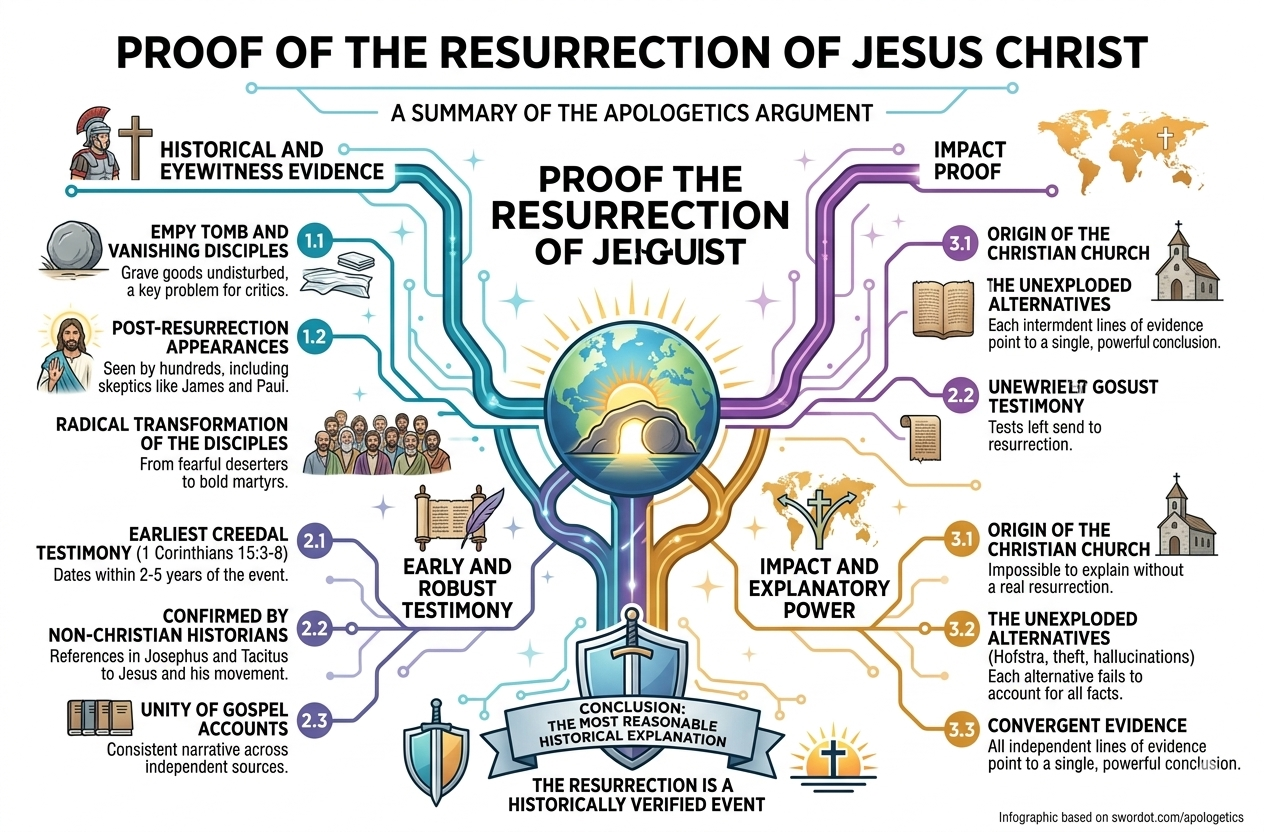
The resurrection of Jesus Christ is the cornerstone of Christian theology. While it is ultimately a matter of faith, historians, theologians, and scholars often point to a specific cluster of historical and circumstantial evidence to argue for its validity.
Here are the primary arguments and points used to prove the resurrection:
1. The Empty Tomb
Perhaps the most foundational piece of evidence is that Jesus’ tomb was found empty just days after his public execution.
*The Roman Guard and Seal: The tomb was heavily secured by a Roman guard and a Roman seal. A stolen body would have required overpowering disciplined soldiers, which was highly unlikely for a scattered, terrified group of disciples.
*The Location: Jesus was crucified and buried in Jerusalem. If the tomb weren’t empty, the Jewish and Roman authorities could have easily produced the body to crush the early Christian movement in its tracks. They never did.
2. The Testimony of Women
In first-century Jewish and Roman culture, the testimony of women was not legally admissible in court and held very little social weight.
* All four Gospel accounts state that women (such as Mary Magdalene) were the first to discover the empty tomb and witness the risen Christ.
* If the story had been fabricated to convince the public, the writers would have chosen high-status male witnesses to make the account credible in that era. Including women as the primary witnesses points to the historical honesty of the report.
3. Eye-Witness Accounts and Post-Resurrection Appearances
The New Testament records numerous instances where Jesus appeared to people after his death, under various circumstances.
* He appeared to individuals (Mary Magdalene, Peter, James), to the twelve disciples as a group, and, according to the Apostle Paul in 1 Corinthians 15:6, to more than 500 people at one time.
* Paul noted that most of these 500 witnesses were still alive at the time of his writing, essentially challenging skeptics to go interview them.
4. The Radical Transformation of the Disciples
Following the crucifixion, the disciples were terrified, disillusioned, and hiding behind locked doors. Yet, just weeks later, they emerged as bold proclaimers of the resurrection, facing intense persecution.
*Martyrdom: Almost all of the original disciples went on to die brutal deaths (execution, crucifixion, stoning) for their claim that Jesus rose from the dead.
* People might die for a lie they *think* is the truth, but no one willingly dies for a lie they *know* they made up. Their willingness to die proves they sincerely believed they had seen the risen Christ.
5. The Conversion of Skeptics
The resurrection account is further strengthened by the sudden conversion of key figures who were previously hostile or highly skeptical.
*Paul (Saul of Tarsus): He was a violent persecutor of the early Church. After claiming to encounter the risen Jesus on the road to Damascus, he became the ultimate Christian missionary and wrote a massive portion of the New Testament.
*James, the Brother of Jesus: The Gospels note that Jesus’ own brothers did not believe in Him during His earthly ministry. Yet, after the resurrection, James became a leader of the Jerusalem church and was eventually martyred for his faith.
6. The Emergence and Growth of the Church
The Christian Church began in Jerusalem, the very city where Jesus was publicly executed.
* Despite fierce opposition from both the Jewish religious establishment and the Roman Empire, the movement exploded in growth.
* The sudden shift of thousands of orthodox Jews changing their sacred, centuries-old traditions—such as shifting the day of worship from the Sabbath (Saturday) to Sunday (the day Jesus rose)—requires a massive catalyst to explain it.
Summary: The historical data—the empty tomb, the eyewitnesses, the sudden transformation of the disciples, and the rapid rise of the Church—presents a compelling case that something monumental occurred.
non-Christian sources that historical scholars rely on to confirm that Jesus existed and was crucified
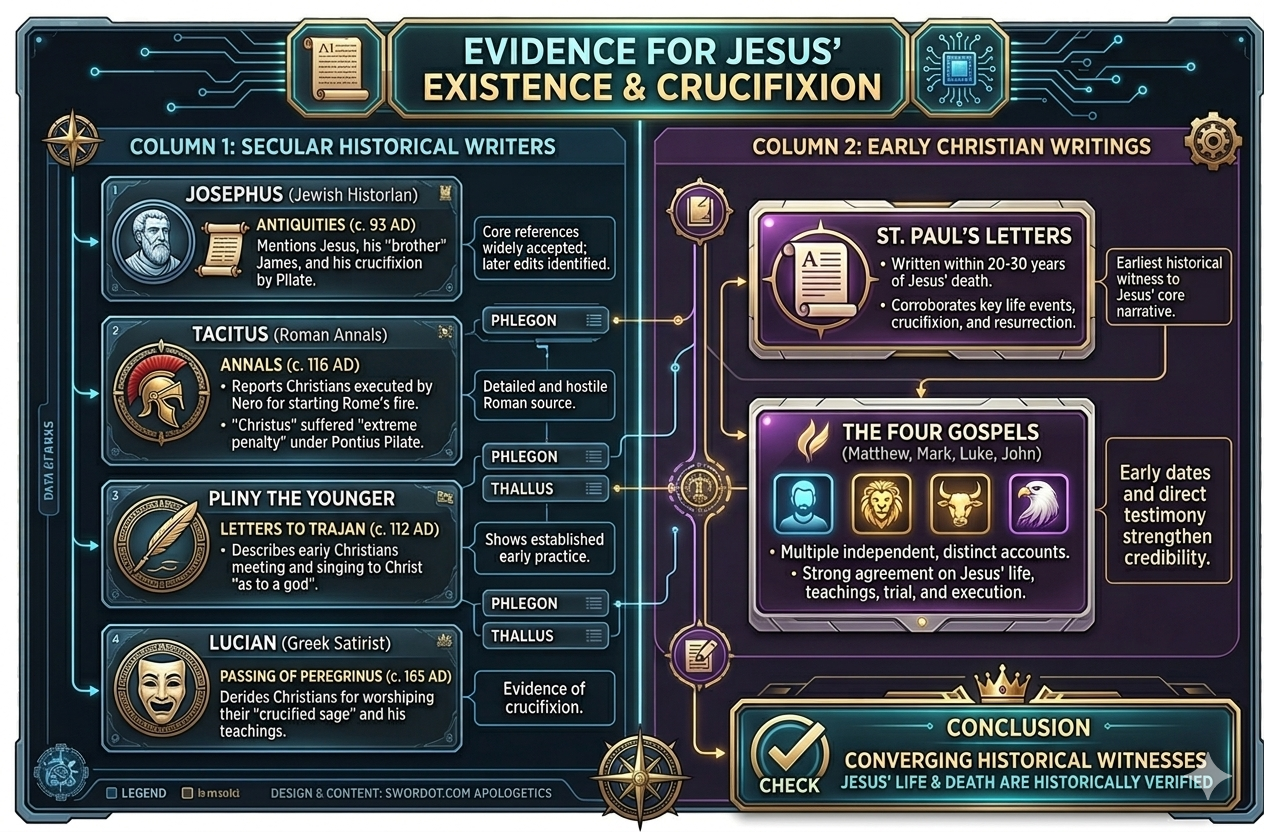
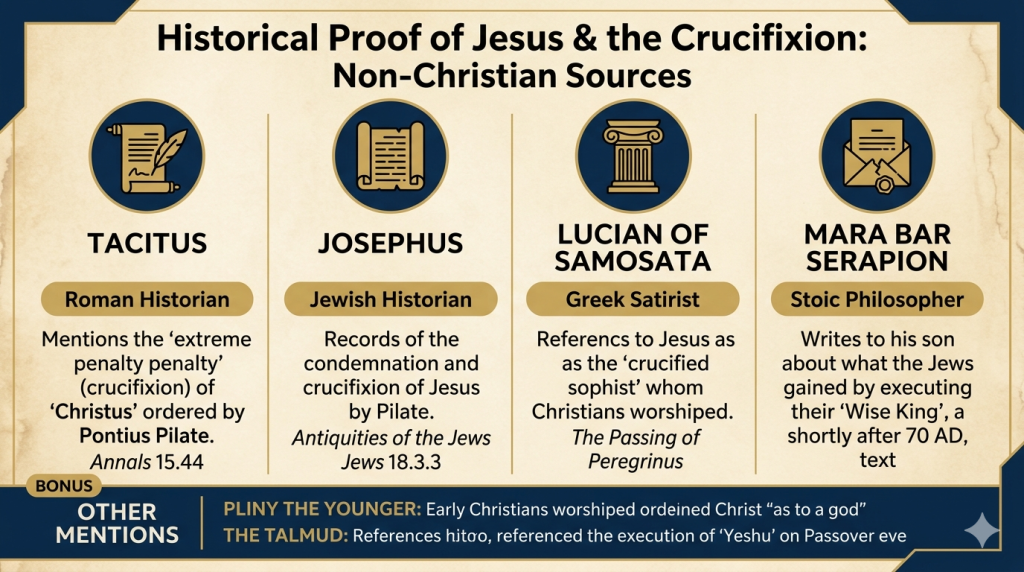
Here are the primary non-Christian sources that historical scholars rely on to confirm that Jesus existed and was crucified.
1. Cornelius Tacitus (c. 56 – c. 120 CE)
Tacitus is widely considered one of the greatest Roman historians. In his final major work, Annals (written around 116 CE), he chronicles the Great Fire of Rome in 64 CE. He explains how Emperor Nero blamed the Christians to deflect rumors from himself, and explicitly details the origin of the group:
”Christus, from whom the name had its origin, suffered the extreme penalty during the reign of Tiberius at the hands of one of our procurators, Pontius Pilatus…”
Why it matters: The “extreme penalty” (supplicium) in the Roman world explicitly referred to crucifixion. This is universally regarded by historians as a highly reliable, independent Roman confirmation of Jesus’s execution under Pilate.
2. Flavius Josephus (c. 37 – c. 100 CE)
Josephus was a first-century Jewish historian who wrote for a Roman audience. In his massive work Antiquities of the Jews (written around 93–94 CE), he mentions Jesus twice.
The most famous passage is the Testimonium Flavianum (Book 18, Chapter 3). While scholars agree that later Christian scribes inserted some overtly religious language into this text (like calling him the Messiah), a core historical statement is widely accepted as authentic Josephus:
”Now there was about this time Jesus, a wise man… He drew over to him both many of the Jews and many of the Gentiles… And when Pilate, at the suggestion of the principal men amongst us, had condemned him to the cross, those that loved him at the first did not forsake him…”
Why it matters: It confirms Jesus as a teacher who gained a following among both Jews and Greeks, and that he was condemned to the cross by Pontius Pilate at the urging of local Jewish leaders.
3. Lucian of Samosata (c. 125 – after 180 CE)
Lucian was a well-known Greek satirist and rhetorician. He was fiercely critical of religion and mocked Christians in his work The Passing of Peregrinus (written around 165 CE). Even in his mockery, he notes the historical reality of their founder:
”The Christians, you know, worship a man to this day—the distinguished personage who introduced their novel rites, and was crucified on that account.”
Why it matters: Lucian refers to Jesus as a “crucified sophist” (philosopher/teacher). Because Lucian was actively mocking Christians, he had absolutely no reason to invent a historic leader for them.
4. Mara bar Serapion (written after 73 CE)
This is a personal letter written in Syriac by a Stoic philosopher from Syria named Mara bar Serapion to his son. He wrote it from a Roman prison, encouraging his son to pursue wisdom. He compares the unjust deaths of three wise men: Socrates, Pythagoras, and a “wise King” of the Jews:
”What advantage did the Athenians gain from putting Socrates to death?… Or the Jews by the murder of their wise King, seeing that from that very time their kingdom was driven away from them?… Nor did the wise King die for good; he lived on in the teaching which he had given.”
Why it matters: While he doesn’t use the name “Jesus,” virtually all scholars agree this is a reference to him, given the timing and the reference to the destruction of Jerusalem (”their kingdom was driven away”). It points to his execution by the Jewish people/authorities of that time.
While the following sources do not explicitly detail his crucifixion, they are frequently cited to prove his historical existence:
Josephus (The Second Mention): In Book 20 of Antiquities, Josephus records the execution of James, whom he describes as “the brother of Jesus, who was called Christ.” This passage is almost universally accepted by scholars as entirely authentic and free of Christian tampering.
Pliny the Younger (c. 61 – 113 CE): A Roman governor who wrote a letter to Emperor Trajan asking how to handle Christians. He notes that they meet regularly and “sing in alternate verses a hymn to Christ, as to a god.”
The Babylonian Talmud: Compiled centuries later, these Jewish rabbinic texts contain a few highly controversial passages thought to refer to Jesus (often called “Yeshu”). One famous passage (Sanhedrin 43a) states that “Yeshu” was hanged/executed on the eve of Passover for practicing sorcery and enticing Israel into apostasy.