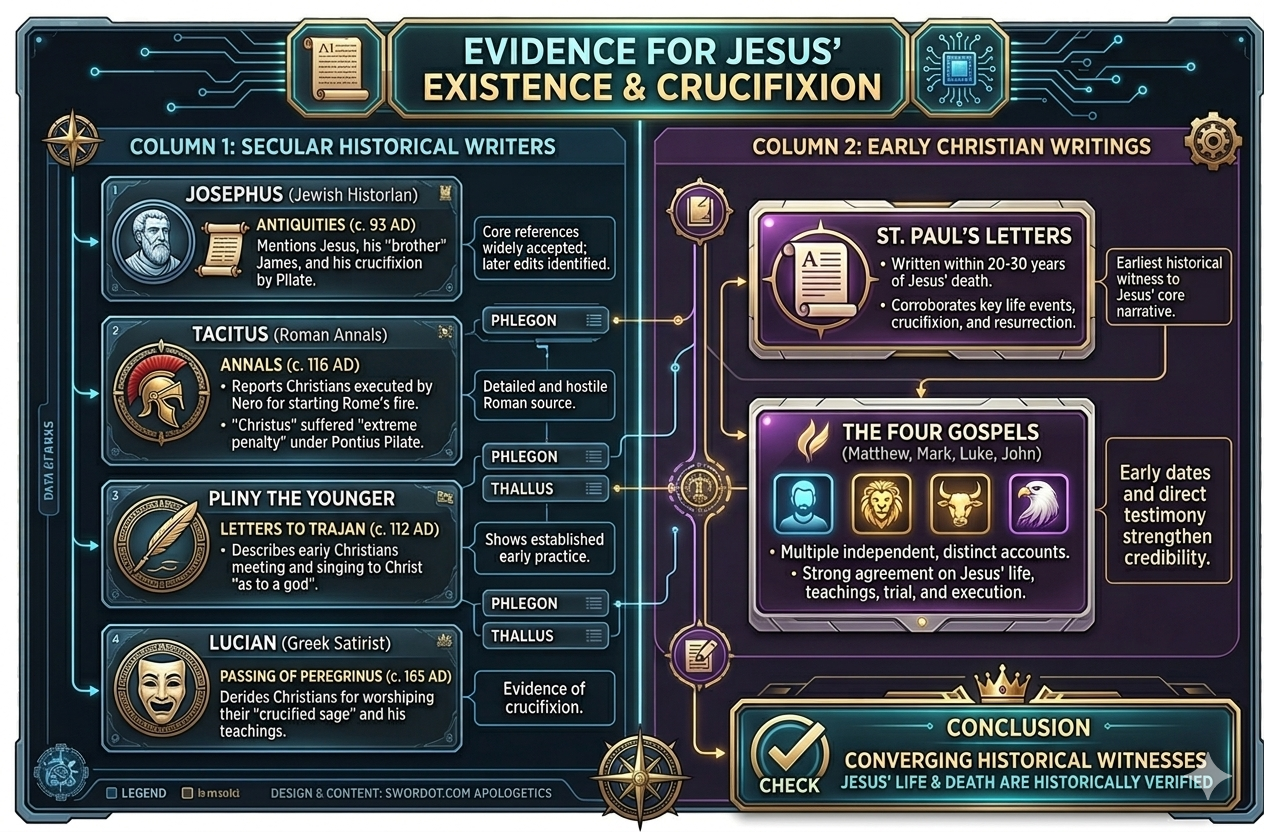
non-Christian sources that historical scholars rely on to confirm that Jesus existed and was crucified
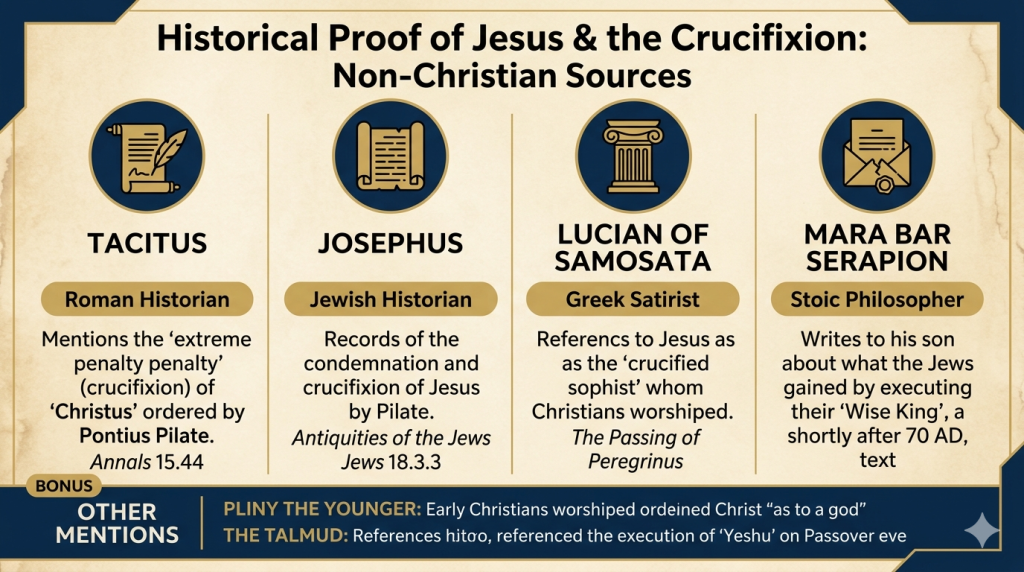
Here are the primary non-Christian sources that historical scholars rely on to confirm that Jesus existed and was crucified.
1. Cornelius Tacitus (c. 56 – c. 120 CE)
Tacitus is widely considered one of the greatest Roman historians. In his final major work, Annals (written around 116 CE), he chronicles the Great Fire of Rome in 64 CE. He explains how Emperor Nero blamed the Christians to deflect rumors from himself, and explicitly details the origin of the group:
”Christus, from whom the name had its origin, suffered the extreme penalty during the reign of Tiberius at the hands of one of our procurators, Pontius Pilatus…”
Why it matters: The “extreme penalty” (supplicium) in the Roman world explicitly referred to crucifixion. This is universally regarded by historians as a highly reliable, independent Roman confirmation of Jesus’s execution under Pilate.
2. Flavius Josephus (c. 37 – c. 100 CE)
Josephus was a first-century Jewish historian who wrote for a Roman audience. In his massive work Antiquities of the Jews (written around 93–94 CE), he mentions Jesus twice.
The most famous passage is the Testimonium Flavianum (Book 18, Chapter 3). While scholars agree that later Christian scribes inserted some overtly religious language into this text (like calling him the Messiah), a core historical statement is widely accepted as authentic Josephus:
”Now there was about this time Jesus, a wise man… He drew over to him both many of the Jews and many of the Gentiles… And when Pilate, at the suggestion of the principal men amongst us, had condemned him to the cross, those that loved him at the first did not forsake him…”
Why it matters: It confirms Jesus as a teacher who gained a following among both Jews and Greeks, and that he was condemned to the cross by Pontius Pilate at the urging of local Jewish leaders.
3. Lucian of Samosata (c. 125 – after 180 CE)
Lucian was a well-known Greek satirist and rhetorician. He was fiercely critical of religion and mocked Christians in his work The Passing of Peregrinus (written around 165 CE). Even in his mockery, he notes the historical reality of their founder:
”The Christians, you know, worship a man to this day—the distinguished personage who introduced their novel rites, and was crucified on that account.”
Why it matters: Lucian refers to Jesus as a “crucified sophist” (philosopher/teacher). Because Lucian was actively mocking Christians, he had absolutely no reason to invent a historic leader for them.
4. Mara bar Serapion (written after 73 CE)
This is a personal letter written in Syriac by a Stoic philosopher from Syria named Mara bar Serapion to his son. He wrote it from a Roman prison, encouraging his son to pursue wisdom. He compares the unjust deaths of three wise men: Socrates, Pythagoras, and a “wise King” of the Jews:
”What advantage did the Athenians gain from putting Socrates to death?… Or the Jews by the murder of their wise King, seeing that from that very time their kingdom was driven away from them?… Nor did the wise King die for good; he lived on in the teaching which he had given.”
Why it matters: While he doesn’t use the name “Jesus,” virtually all scholars agree this is a reference to him, given the timing and the reference to the destruction of Jerusalem (”their kingdom was driven away”). It points to his execution by the Jewish people/authorities of that time.
Other Notable Non-Christian Mentions (Existence Only)
While the following sources do not explicitly detail his crucifixion, they are frequently cited to prove his historical existence:
Josephus (The Second Mention): In Book 20 of Antiquities, Josephus records the execution of James, whom he describes as “the brother of Jesus, who was called Christ.” This passage is almost universally accepted by scholars as entirely authentic and free of Christian tampering.
Pliny the Younger (c. 61 – 113 CE): A Roman governor who wrote a letter to Emperor Trajan asking how to handle Christians. He notes that they meet regularly and “sing in alternate verses a hymn to Christ, as to a god.”
The Babylonian Talmud: Compiled centuries later, these Jewish rabbinic texts contain a few highly controversial passages thought to refer to Jesus (often called “Yeshu”). One famous passage (Sanhedrin 43a) states that “Yeshu” was hanged/executed on the eve of Passover for practicing sorcery and enticing Israel into apostasy.
Leave a Reply