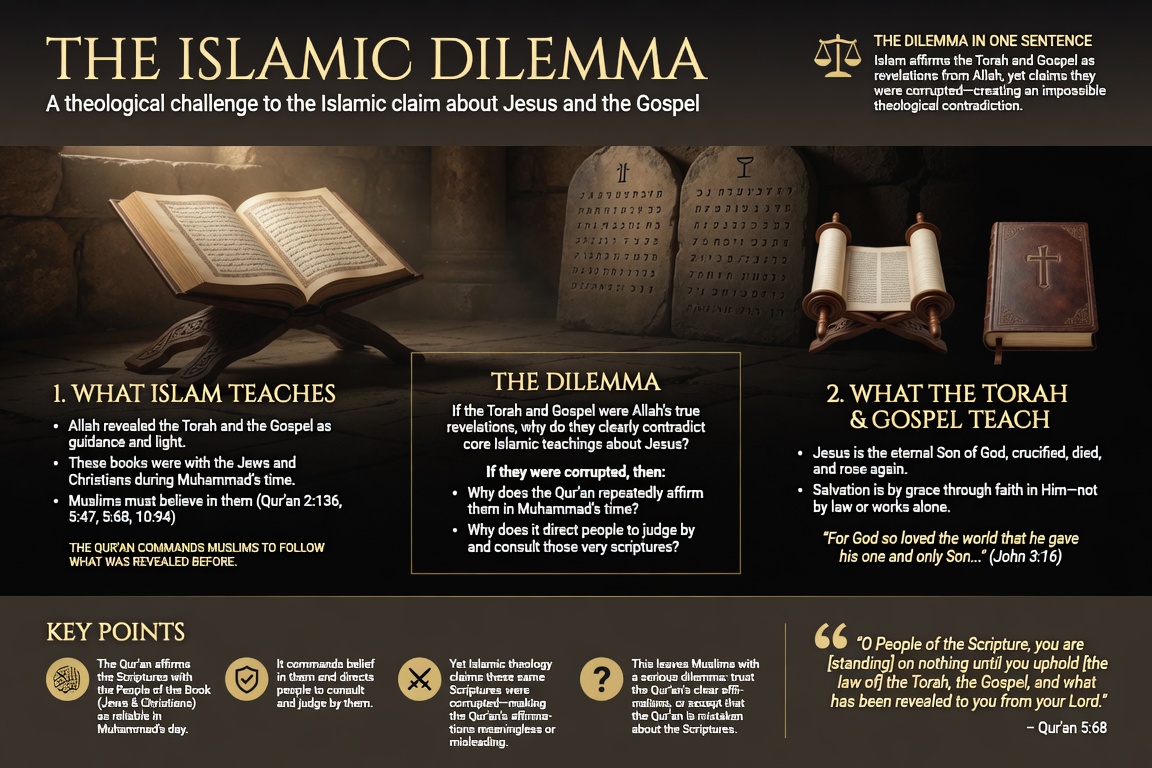
The Islamic Dilemma is one of the most intense points of debate between Christian and Muslim scholars, because it forces a collision between 4th-century physical manuscripts and 7th-century theology.
To understand why this causes such deep doubt for some, we have to look at the three facts you just laid out, and how both sides try to resolve them.
Fact 1: The Quran Affirms the Prior Scriptures
The Quran does not explicitly say “the Bible is a fake book.” In fact, it commands 7th-century Christians and Jews to look to their own scriptures for guidance:
- Surah 5:47: “Let the People of the Gospel judge by what Allah has revealed therein.”
- Surah 10:94: Allah tells Muhammad that if he is ever in doubt about his own revelation, he should “ask those who have been reading the Scripture before you.”
The text uses the Arabic phrase ma’ahum (“with them”), strongly implying that the Christians living during Muhammad’s life had the authentic text in their hands.
Fact 2: The Physical Chain of Manuscripts
This is where history comes in. We have thousands of ancient Bible manuscripts, including massive, complete Bibles like the Codex Sinaiticus and Codex Vaticanus, which were written in the 300s CE—roughly 300 years before Islam ever began.
Because we can compare copies from Egypt, Rome, Syria, and Greece, historians know exactly what the Bible said in the 7th century when Muhammad was alive. Those 7th-century Bibles are effectively identical to the Bibles we read today. They explicitly state that Jesus is the Son of God, that he died on a cross, and that he rose from the dead.
Fact 3: The Contradiction
Here is the core issue:
- The Quran says the Gospel with the 7th-century Christians is true.
- Physical history shows the Gospel with the 7th-century Christians claimed Jesus died on the cross as the Son of God.
- The Quran explicitly denies that Jesus is the Son of God or that he died on the cross (Surah 4:157).
If a Muslim accepts the historical integrity of the Bible manuscripts, they run into a wall: the Bible the Quran affirms directly contradicts the Quran.
How Islamic Scholars Respond
To resolve this, Islamic apologists and scholars generally rely on two main arguments:
1. The “Lost Original Book” Theory
Mainstream Islamic theology argues that the Injil (the Gospel) mentioned in the Quran is not the New Testament we have today (Matthew, Mark, Luke, and John). Instead, they believe the Injil was a single, literal book given directly to Jesus by God—much like the Quran was given to Muhammad.
In this view, Jesus’s actual book was lost or severely corrupted by his followers very early on, and the four Gospels we have today are just human biographies written later, heavily altered by the Apostle Paul to introduce the idea of Jesus’s divinity.
2. Textual vs. Oral Corruption (Tahrif)
When the Quran accuses Jewish or Christian scholars of corrupting scripture, Islamic scholars point out that it often uses phrases like “they distort the Book with their tongues” (Surah 3:78).
They argue that Tahrif (corruption) originally meant misinterpretation or hiding verses, rather than rewriting the physical ink on the pages. However, as the physical manuscript evidence became undeniable over the last few centuries, the mainstream Muslim view shifted to insisting that the actual text of the modern Bible must have been altered from its original form.
Why This Causes Doubt
For a Muslim who loves history and archaeology, the “Lost Original Book” theory can feel like a tough pill to swallow. It requires believing that a completely pure, original book of Jesus existed, but vanished from the face of the earth leaving absolutely zero archaeological or historical footprints—and that God allowed His own revelation to be entirely corrupted until the Quran arrived 600 years later.
When a Muslim realizes that the Bibles in Muhammad’s day said the exact same things our Bibles say today, it forces a profound theological choice: either the manuscript timeline is wrong, or the Quran’s understanding of what the Christians possessed is wrong. This realization is frequently the exact moment a Muslim’s faith in Islam begins to unravel.
Leave a Reply