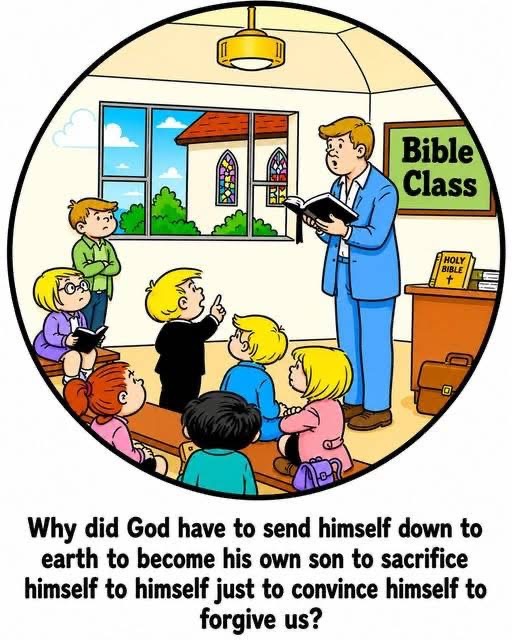
This image highlights a common, satirical summary of Christian theology, but from a mainstream Christian perspective (Trinitarianism), it oversimplifies and misrepresents the doctrine of the Incarnation and Atonement.
Here is how mainstream Christian theology breaks down the concepts involved in that question:
1. “God sent himself down… to become his own son”
The Oversimplification: This phrasing assumes Modalism (or Sabellianism)—an ancient view rejected by mainstream Christianity which holds that God is a single person who simply shifts roles or “wears different masks” (Father, Son, Spirit).
The Christian View: The doctrine of the Trinity states that God is one God in three distinct Persons: God the Father, God the Son (Jesus Christ), and God the Holy Spirit. They share the exact same divine essence, but the Father is not the Son, and the Son is not the Father. So, the Father sent the Son; God did not literally “become His own Son.”
2. “To sacrifice himself to himself”
The Oversimplification: It frames the sacrifice as a strange internal transaction where God appeases a arbitrary urge of His own.
The Christian View: In Christian theology (particularly views like Substitutionary Atonement), God’s character involves both perfect justice and perfect love:
Justice: Sin carries a real moral weight and consequence (separation from God/death). God cannot simply ignore or sweep evil under the rug without compromising perfect justice.
Love: Rather than requiring humanity to pay the penalty it could never satisfy, God takes the burden upon Himself. The Son willingly absorbs the consequence of human sin on the cross to satisfy the demands of divine justice while offering mercy.
3. “Just to convince himself to forgive us?”
The Oversimplification: It presents God as reluctant or needing to “trick” or “persuade” Himself into being forgiving.
The Christian View: In Christian teaching, God didn’t need to be convinced to love humanity—love was the motivation from the very start. As John 3:16 states, “For God so loved the world that he gave his only begotten Son…” The sacrifice wasn’t to change God’s heart toward humans, but to provide a righteous, legal, and moral framework for reconciling humanity to God without ignoring moral wrongdoing.
In short: As a meme critique of Modalism, it makes a logical point. But as a characterization of traditional Christian doctrine, it collapses distinct personal relationships within the Trinity and misinterprets the relationship between God’s justice and love.
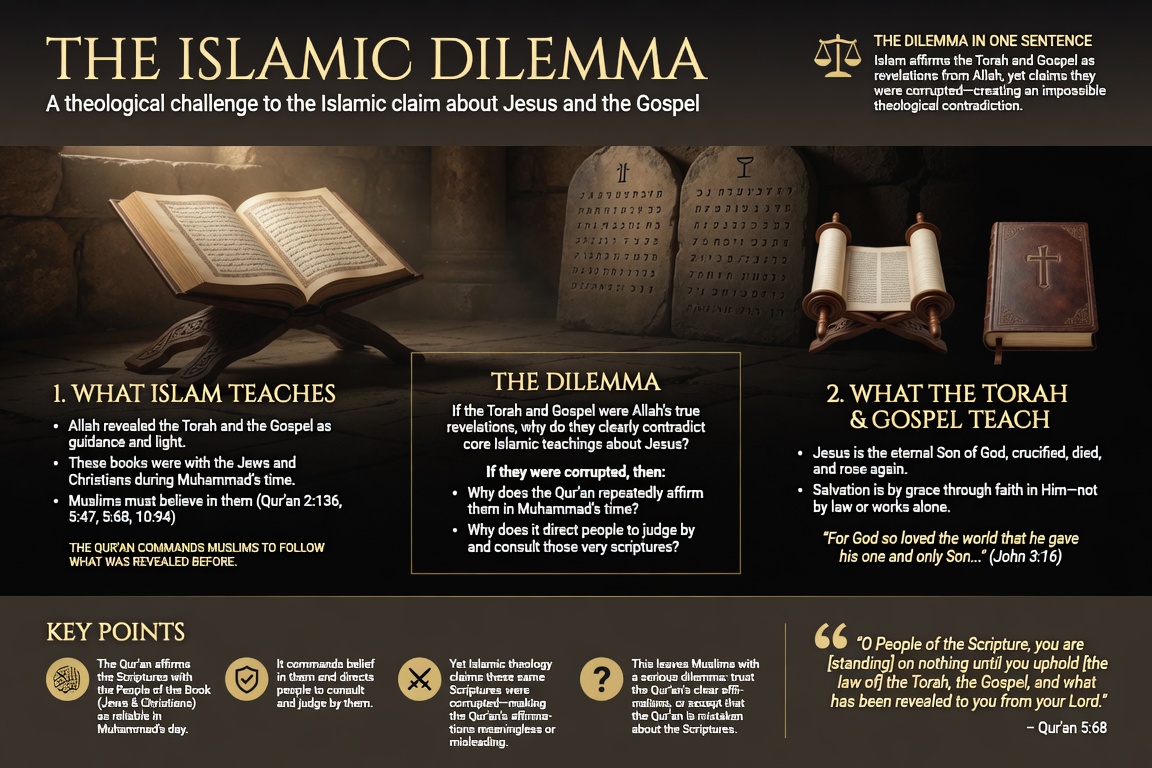
The Islamic Dilemma is one of the most intense points of debate between Christian and Muslim scholars, because it forces a collision between 4th-century physical manuscripts and 7th-century theology. To understand why this causes such deep doubt for some, we have to look at the three facts you just laid out, and how both sides try to resolve them.
Fact 1: The Quran Affirms the Prior Scriptures
The Quran does not explicitly say “the Bible is a fake book.” In fact, it commands 7th-century Christians and Jews to look to their own scriptures for guidance:
Surah 5:47:“Let the People of the Gospel judge by what Allah has revealed therein.”
Surah 10:94: Allah tells Muhammad that if he is ever in doubt about his own revelation, he should “ask those who have been reading the Scripture before you.” The text uses the Arabic phrase ma’ahum (“with them”), strongly implying that the Christians living during Muhammad’s life had the authentic text in their hands.
Fact 2: The Physical Chain of Manuscripts
This is where history comes in. We have thousands of ancient Bible manuscripts, including massive, complete Bibles like the Codex Sinaiticus and Codex Vaticanus, which were written in the 300s CE—roughly 300 years before Islam ever began. Because we can compare copies from Egypt, Rome, Syria, and Greece, historians know exactly what the Bible said in the 7th century when Muhammad was alive. Those 7th-century Bibles are effectively identical to the Bibles we read today. They explicitly state that Jesus is the Son of God, that he died on a cross, and that he rose from the dead.
Fact 3: The Contradiction
Here is the core issue:
The Quran says the Gospel with the 7th-century Christians is true.
Physical history shows the Gospel with the 7th-century Christians claimed Jesus died on the cross as the Son of God.
The Quran explicitly denies that Jesus is the Son of God or that he died on the cross (Surah 4:157). If a Muslim accepts the historical integrity of the Bible manuscripts, they run into a wall: the Bible the Quran affirms directly contradicts the Quran.
How Islamic Scholars Respond
To resolve this, Islamic apologists and scholars generally rely on two main arguments:
1. The “Lost Original Book” Theory
Mainstream Islamic theology argues that the Injil (the Gospel) mentioned in the Quran is not the New Testament we have today (Matthew, Mark, Luke, and John). Instead, they believe the Injil was a single, literal book given directly to Jesus by God—much like the Quran was given to Muhammad. In this view, Jesus’s actual book was lost or severely corrupted by his followers very early on, and the four Gospels we have today are just human biographies written later, heavily altered by the Apostle Paul to introduce the idea of Jesus’s divinity.
2. Textual vs. Oral Corruption (Tahrif)
When the Quran accuses Jewish or Christian scholars of corrupting scripture, Islamic scholars point out that it often uses phrases like “they distort the Book with their tongues” (Surah 3:78). They argue that Tahrif (corruption) originally meant misinterpretation or hiding verses, rather than rewriting the physical ink on the pages. However, as the physical manuscript evidence became undeniable over the last few centuries, the mainstream Muslim view shifted to insisting that the actual text of the modern Bible must have been altered from its original form.
Why This Causes Doubt
For a Muslim who loves history and archaeology, the “Lost Original Book” theory can feel like a tough pill to swallow. It requires believing that a completely pure, original book of Jesus existed, but vanished from the face of the earth leaving absolutely zero archaeological or historical footprints—and that God allowed His own revelation to be entirely corrupted until the Quran arrived 600 years later. When a Muslim realizes that the Bibles in Muhammad’s day said the exact same things our Bibles say today, it forces a profound theological choice: either the manuscript timeline is wrong, or the Quran’s understanding of what the Christians possessed is wrong. This realization is frequently the exact moment a Muslim’s faith in Islam begins to unravel.
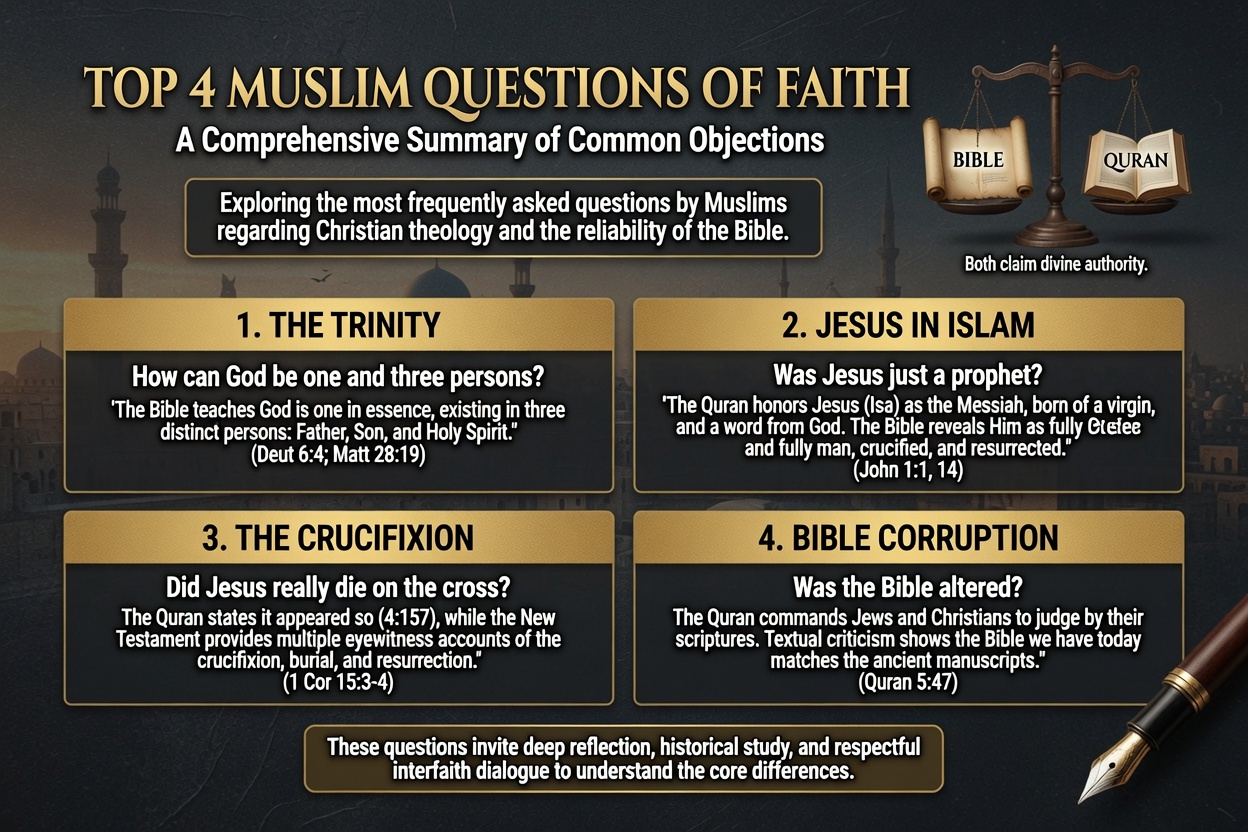
When Muslims experience a crisis of faith that leads them to explore or convert to Christianity, it usually isn’t a single question that flips a switch. Instead, it is typically a gradual shift driven by theological tensions, emotional experiences, or deep personal inquiries. In comparative religion and ministries that work with Muslim-background believers (MBBs), several core questions and themes consistently emerge as the primary catalysts for doubt and subsequent conversion.
1. Assurance of Salvation: “How can I know for sure if God accepts me?”
In mainstream Islamic theology, salvation is ultimately dependent on the will of Allah, paired with a person’s balance of good and bad deeds. Even a highly devout Muslim cannot definitively claim they are going to Paradise (Jannah), as doing so is often seen as assuming God’s judgment.
The Doubt: This can create a sense of spiritual anxiety or a feeling of being on a “treadmill” of religious performance, leaving people wondering if they have prayed, fasted, or repented enough.
The Christian Alternative: Christianity introduces the concept of grace and permanent assurance through the substitutionary atonement of Jesus (the belief that Jesus paid for human sins on the cross). The shift from “I hope I have done enough” to “It has already been done for me” is often the most profound theological turning point.
2. The Nature of God: “Is God a distant master or a loving father?”
While Islamic tradition heavily emphasizes God’s mercy and compassion, the fundamental framework of the relationship between God and humanity is that of Master (Rabb) and servant/slave (Abd). Calling God “Father” is strictly rejected in Islam, as it is viewed as compromising God’s transcendent majesty.
The Doubt: Some Muslims experience a deep longing for a personal, intimate relationship with the divine that feels difficult to achieve within a framework focused heavily on legalism and submission.
The Christian Alternative: The Christian concept of God as an intimate, approachable Father who desires a personal relationship—and who “first loved us” while we were still sinners—appeals deeply to those seeking personal spiritual connection.
3. Historical and Moral Consistency: “Who was the Prophet Muhammad vs. Who was Jesus?”
As Muslims grow older or gain access to broader historical resources (often via the internet or diaspora communities), some begin to critically examine the Hadith (the recorded sayings and actions of Muhammad).
The Doubt: Questions frequently arise regarding the moral complexities of Muhammad’s life, including his multiple marriages, his execution of military campaigns, or specific legal rulings. When compared to the peaceful, non-violent narrative of Jesus (Isa in Islam) presented in both the Quran and the New Testament Gospels, some find a stark contrast.
The Christian Alternative: Because Islam already holds Jesus in incredibly high regard as a sinless, virgin-born prophet who performed miracles and ascended to heaven, exploring his life further feels natural. When Muslims read the Gospels for themselves, Jesus’s teachings on radical forgiveness, loving one’s enemies, and elevating the marginalized often present a compelling moral alternative.
4. The Integrity of Scripture: “Has the Bible actually been corrupted?”
Traditional Islamic teaching maintains that the Christian and Jewish scriptures were Tahrif (corrupted or altered over time), and that the Quran arrived to correct those errors.
The Doubt: When textually curious Muslims begin looking into biblical archaeology, manuscript history, and textual criticism, many conclude that the New Testament has a highly reliable, deeply documented transmission history. If the Bible wasn’t corrupted, then its claims about Jesus being the Son of God who died on the cross directly contradict the Quran’s claim that he didn’t die.
The Christian Alternative: Realizing that the historical evidence supports the early transmission of Christian texts forces a choice between the historical record of the New Testament and the theological claims of the Quran.
The Role of Dreams and Visions
Beyond intellectual questions, a unique and widely documented phenomenon among Muslims who convert to Christianity is the role of dreams and visions. In Middle Eastern and South Asian cultures, dreams are taken very seriously as a legitimate medium for divine communication. Countless converts report having vivid, deeply peaceful dreams of a figure in white whom they intuitively understand to be Jesus, telling them to follow him or offering them comfort during a time of intense personal trial. These supernatural experiences frequently act as the catalyst that prompts them to seek out a Bible or visit a church in the first place.
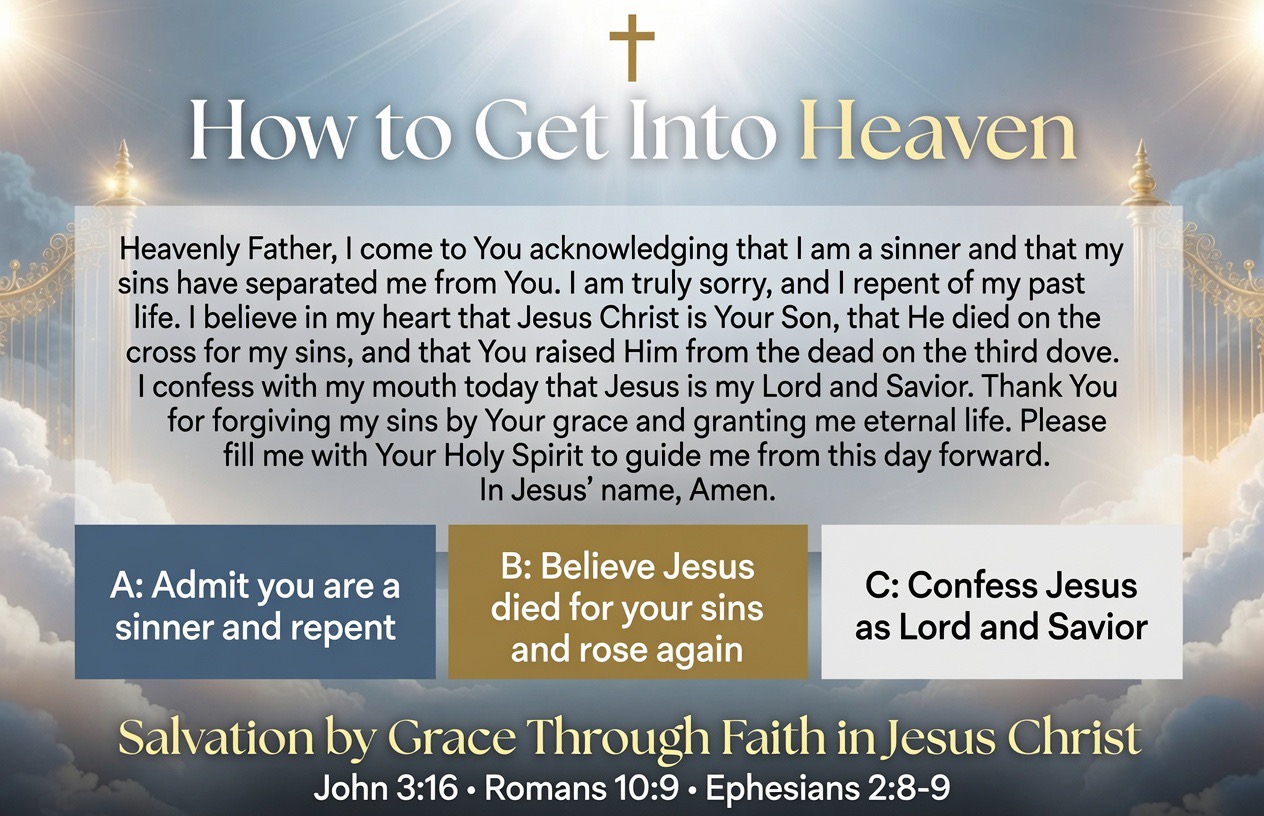
I come to You acknowledging that I am a sinner and that my sins have separated me from You. I am truly sorry, and I repent of my past life.
I believe in my heart that Jesus Christ is Your Son, that He died on the cross for my sins, and that You raised Him from the dead on the third day. I confess with my mouth today that Jesus is my Lord and Savior.
Thank You for forgiving my sins by Your grace and granting me eternal life. Please fill me with Your Holy Spirit to guide me from this day forward.
In this video, speaker Wes Huff outlines 6 reasons why he remains a convictional Protestant rather than a Roman Catholic. He frames his arguments around the core concept of sufficiency—arguing that while Catholics agree many of these components are necessary, Protestants believe they are entirely sufficient on their own.
Here is a summary of the main points he makes, organized by the reasons he presents, along with every Bible verse he quotes.
1. The Sufficiency of Scripture
The Protestant View: Scripture is unique because it is the literal speech of God. It functions as the ultimate and infallible rule for faith and practice. While church tradition has a “voice,” Scripture has the final “veto” (a ministerial authority vs. Rome’s magisterial authority).
The Catholic Contrast: The Council of Trent established a dual-source framework, affirming that infallible truth and the rule of salvation exist in both written Scripture and unwritten church traditions.
2. The Sufficiency of Faith
The Protestant View: Justification is a definitive, judicial moment in time where God pronounces a believer righteous based entirely on faith in Jesus Christ, excluding any human deeds or religious rituals.
The Catholic Contrast: Justification is viewed as a lifelong, progressive process. Grace is infused into the believer through sacraments (baptism, mass, etc.), making salvation a cooperative effort between God’s grace and human effort.
Verses Quoted:
Hebrews 11:6 & Romans 8:8 [00:09:49] – Used to argue that humans in their fallen state possess no inherent capacity to do works that please God or contribute to their own salvation.
Romans 8:1 [00:12:15] – Quoted to emphasize the security and finality of Christ’s work: “There is therefore now no condemnation for those who are in Christ Jesus.”
3. The Sufficiency of Grace
The Protestant View: Grace is God’s sovereign, transformative power that saves entirely on its own, independent of human merit or organizational mediation.
The Catholic Contrast: Grace is a substance dispensed through the church’s channels that enables salvation but requires human ascent and cooperation to be completed.
Verses Quoted:
Romans 11:6 [00:13:38] – Points out that if salvation is by grace, it cannot simultaneously rest on works, otherwise grace ceases to be grace.
2 Corinthians 12:9 [00:13:58] – Highlights the completeness of God’s grace: “My grace is sufficient for you.”
2 Timothy 1:9 [00:14:06] – Used to show that salvation is based on God’s own purpose and grace given before time began, not human cooperation.
4. The Papacy
The Protestant View: The office of the Pope is not biblically or historically supported. Historically, a singular ruling Bishop of Rome did not exist in the 1st or early 2nd centuries; early church letters point to a collegiate leadership of multiple elders.
The Catholic Contrast: The Pope is the Bishop of Rome, the successor of Peter, and the supreme earthly vicar of Christ holding universal jurisdiction over the Church.
Verses Quoted:
Matthew 16:18 [00:14:57] – “And I tell you, you are Peter, and on this rock I will build my church…” Huff reads the Greek text on-screen [00:16:51] to argue that Jesus was building the church on Peter’s confession of Christ’s identity, not on Peter’s person or a line of papal successors.
5. Prayer to the Saints
The Protestant View: Throughout the Bible, prayer is exclusively a dialogue addressed to the divine and is fundamentally an act of worship. Requesting the dead to intercede breaks down scripturally and historically degrades into superstition.
The Catholic Contrast: Distinction is made between latria (worship due to God alone) and dulia (veneration given to saints). Asking a saint in heaven to pray for you is viewed as no different than asking a friend on earth to pray for you.
Verses Quoted:
Romans 1:7 [00:21:56] & 1 Corinthians 1:2 [00:22:05] – Quoted to demonstrate that the New Testament explicitly labels all living believers as “saints,” rather than restricting the title to an elite, canonized group in heaven.
6. The Sacrifice of the Mass
The Protestant View: The Lord’s Table is a celebratory remembrance of a finished event, moving “heavenly downward” as a gift of grace to the church. The author of Hebrews clarifies that Christ’s sacrifice was a final, non-repeatable event.
The Catholic Contrast: The Mass is a literal, propitiatory (wrath-appeasing) sacrifice. It is an “unbloody” re-presentation where the priest offers Christ up to God the Father (“earthly upward”) for the ongoing remission of sins.
Scripture Referenced:
Hebrews 9 & 10 [00:30:02] – Cited broadly to contrast the repeatable Old Covenant sacrifices with the single, “once-for-all” sacrifice of Jesus on the cross.
Additional Point: The “Unchanged” Church & Justification
Huff concludes by noting that church history reveals significant doctrinal developments over time—meaning Rome’s claim of being an “unchanged church” does not hold up under scrutiny. He points out that medieval Catholicism firmly taught that submission to the Pope was entirely necessary for salvation (Unam Sanctam), whereas modern Vatican II theology states that non-Catholics (and even non-Christians like Muslims) can be saved.
He provides an extensive list of verses to wrap up his defense of the Protestant view of forensic justification (being declared righteous rather than made righteous):
Romans 4:4-5 [00:37:47] – Abraham’s faith, not his labor, was counted as righteousness.
Romans 4:25 & 5:1 [00:37:56] – Connects resurrection to justification and peace with God.
Romans 8:33 [00:38:07] – Identifies God as the ultimate entity who justifies.
Romans 4:9(likely intending Romans 5:9) [00:38:17] – Justification through Christ’s blood saves us from future wrath.
Galatians 2:16 [00:38:36] – Explicitly states a person is not justified by works of the law, but through faith.
Romans 3:20-24 & 3:28 [00:38:46] – No one achieves righteousness through law-keeping; justification is a free gift of grace apart from works.
Can Catholics be Christians?
Yes, Huff emphasizes that both Martin Luther and John Calvin explicitly affirmed that true Christians exist within the Roman Catholic Church. However, his final stance is that a Catholic who is truly saved is saved in spite of official Roman Catholic dogma, not because of it.
From a traditional Christian Protestant and King James Version perspective, the short answer is: it isn’t the amount of your faith that saves you, but the object of your faith.
You do not need a mountain of perfect, unwavering faith to get into heaven. Even faith as tiny as a mustard seed is enough, because saving faith is simply trusting in a Savior who does 100 percent of the heavy lifting.
Here is how the KJV Bible breaks this down:
1 It is a Gift, Not a Score
Protestant theology focuses heavily on Justification by Faith Alone. This means heaven isn’t a reward you qualify for by reaching a certain level of faith or doing enough good deeds. It is a free gift that you simply accept.
Ephesians 2:8-9
“For by grace are ye saved through faith; and that not of yourselves: it is the gift of God: Not of works, lest any man should boast.”
1 Even Mustard Seed Faith is Enough
Jesus directly addressed the size of faith. He explained that you don’t need a massive, unshakeable quantity of it to see divine results.
Matthew 17:20
“…If ye have faith as a grain of mustard seed, ye shall say unto this mountain, Remove hence to yonder place; and it shall remove; and nothing shall be impossible unto you.”
1 The Focus is on Who You Trust
Think of faith like a bridge. If you are crossing a massive, rock-solid steel bridge, you can be trembling with fear and doubt the whole way across, but the bridge will still carry you safely to the other side. Your safety doesn’t depend on how brave you feel; it depends on the strength of the bridge.
In the KJV, Jesus is that bridge. Saving faith is simply shifting your trust away from your own goodness and placing it entirely on Jesus’ death and resurrection.
Romans 10:13
“For whosoever shall call upon the name of the Lord shall be saved.”
A Biblical Example: In Mark 9:24, a desperate father comes to Jesus asking for a miracle. He honestly admits the struggle in his heart, crying out, “Lord, I believe; help thou mine unbelief.” Jesus didn’t reject him for having imperfect or small faith—He answered his prayer right then and there.